The word "agent" is doing too much work
If you run a small business, you have been sold an AI agent at least four times this year. The pitch is always the same shape: something autonomous, something that works while you sleep, something that replaces a role you are currently paying for. The demo is impressive. The invoice arrives monthly.
It is worth knowing that the analysts watching this market are unusually blunt about the gap between the pitch and the product. Gartner estimates that of the thousands of vendors now claiming to sell "agentic AI," roughly 130 are genuinely delivering autonomous systems. The firm has a name for the rest of it: agent washing — a chatbot with a new label and a higher price. Gartner also predicts that more than 40% of agentic AI projects will be cancelled by the end of 2027, citing escalating costs, unclear business value, and inadequate risk controls.
None of that means the underlying idea is empty. It means the category is early, and that the difference between a workflow that pays for itself and one that quietly bleeds money is mostly a question of how it is built. So it is worth being precise about what a multi-agent workflow actually is.
One model doing everything is not a workflow
A single chatbot is a generalist. You give it a task, it attempts the whole task, and the quality degrades as the task gets longer and more specific. Ask it to research a competitor, draft an email, check the email against your pricing, and schedule a follow-up, and it will do a mediocre job of all four — because it is holding four different sets of instructions in tension and optimising for none of them.
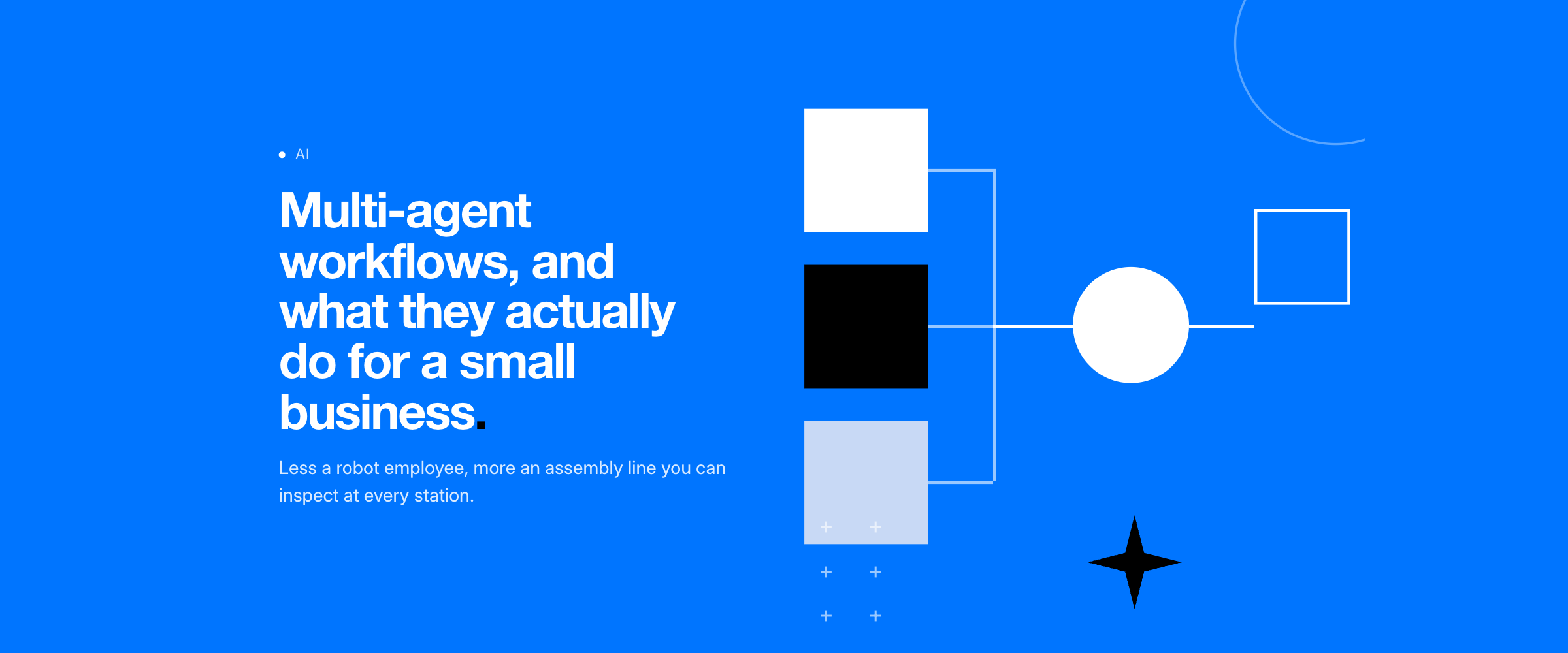
A multi-agent workflow splits that into specialists. One process retrieves and summarises. Another drafts in a defined voice. A third checks the draft against a source of truth — your actual prices, your actual availability, your actual terms. A fourth decides what happens next. Each one has a narrow job, a narrow set of instructions, and a narrow definition of done.
The interesting part is not the agents. It is the orchestration: the layer that decides which specialist runs, in what order, with what inputs, and what happens when one of them fails. That layer is ordinary software engineering. It is deterministic, testable, and boring — and it is the reason well-built systems behave predictably while demo-ware falls apart on the third real input.
This is the practical distinction to hold onto. If a vendor cannot tell you what happens when step three returns nothing, they have sold you a chatbot.
Why the failure rate is so high
McKinsey's 2025 global survey found that 23% of organisations are scaling an AI agent in at least one function — real adoption, but narrow. More telling: only 39% of respondents attribute any EBIT impact at all to AI, and most of those say it accounts for less than 5% of earnings. Nearly two-thirds have not begun scaling across the business.
Read that carefully, because it is not a story about the technology being bad. It is a story about deployment. Organisations are running pilots that work and then failing to connect them to anything that matters. The pilot summarises support tickets beautifully; nobody changed how support is staffed, so the summary is a nice artefact and nothing else.
Three failure modes account for most of it, and all three are avoidable.
The task was never the bottleneck. Automating something that took forty minutes a week produces a saving you cannot measure. If you cannot name the hour it gives back, you are buying a toy.
There is no source of truth to check against. An agent drafting quotes is only useful if it can read your real pricing. If your pricing lives in three spreadsheets and a founder's memory, the agent will invent numbers with total confidence. The data problem always precedes the AI problem.
Nobody owns the output. Autonomous does not mean unsupervised. Systems that work have a named human who reviews a sample, notices drift, and adjusts. Systems that fail were handed to nobody.
Four workflows that hold up at small scale
Set aside the enterprise case studies. Here is where multi-agent workflows genuinely earn their keep in a business with fewer than twenty people.
Inbound triage and qualification. Enquiries arrive through a form, an inbox, a phone transcript, and a social DM. One process normalises them into a single structure. Another enriches each with public context about the company. A third scores them against your actual criteria — budget range, geography, service fit — and routes accordingly. The owner stops reading everything and starts reading the top of a sorted list. The saving is not the reading; it is the response time on the enquiries that matter.
Proposal and quote assembly. A retrieval step pulls the closest three past engagements. A drafting step assembles scope and deliverables in your language. A verification step checks every figure against your rate card and flags anything outside normal bounds. You review and send. Work that took a founder ninety minutes on a Sunday takes fifteen on a Tuesday, and the numbers are checked rather than remembered.
Operational monitoring. This is the one small businesses skip and should not. A scheduled process watches the things that quietly break: a payment that failed, a form that stopped submitting, a page that got slow, a review that went up overnight. It classifies severity and tells one person, once, in the place they already look. Most small-business emergencies are small problems that went unwatched for a fortnight.
Post-delivery follow-through. The unglamorous revenue. A process notices a project closed, drafts a follow-up in your voice with specifics from the actual work, checks it against what was delivered, and queues it for approval. Nobody does this consistently by hand. Systems do it consistently by default.
What connects all four: each one has a measurable before and after, each one reads from a real source of truth, and each one ends with a human decision rather than an autonomous action against the outside world.
The advantage you actually have
Large organisations have budget, specialists, and procurement. They also have twenty years of process debt, four systems of record that disagree, and a change-approval path that takes a quarter. That is precisely why their agent pilots stall in the pilot phase.
A small business has the opposite profile. Fewer systems. Shorter path from idea to production. And — the part that gets undersold — the person specifying the workflow is usually the person who does the work. That is an enormous advantage. Most agentic projects fail on requirements, not on models. When the domain expert and the decision-maker are the same person, the requirements are right the first time.
Gartner's longer view is that 15% of day-to-day work decisions will be made autonomously by 2028, up from effectively zero in 2024. The businesses that get there will not be the ones that bought the most impressive demo in 2026. They will be the ones that automated four boring things properly and learned what to trust.
What stays human
Some things should not be delegated, and being clear about them early prevents the expensive kind of mistake.
Anything that commits you contractually. Anything that touches money leaving the business. Anything that constitutes the first substantive contact with a person who might become a client. Anything where being wrong is publicly embarrassing and hard to retract.
This is not caution for its own sake. It is that these are the moments where your judgment is the product. A client is not buying your ability to generate a proposal — they are buying your read on whether the project is a good idea. Automate the assembly. Keep the judgment.
How to start without betting the business
Pick the workflow that annoys you most and that you can measure. Write down the current cost in hours per week and the current failure rate — how often does a lead go cold, how often does a quote go out wrong. Those two numbers are your baseline, and without them you will never know whether the thing worked.
Build the smallest version that touches real data. Not a demo on sample inputs — the real inbox, the real rate card. This is where most projects discover that the actual problem is that the rate card is three years out of date, which is a genuinely useful thing to discover in week one rather than month six.
Keep a human approval step in place for longer than feels necessary. Review a sample every week. When you have gone a month without changing anything, you have earned the right to loosen it.
Then do the next one. The compounding is not in any single workflow — it is in the fact that the second is faster to build than the first, because the plumbing, the source of truth, and the review habit are already there.
The businesses that will look lucky in three years are doing unglamorous work right now: cleaning up their data, writing down what "good" means, and automating one boring thing at a time. That is the whole trick. There is no version of this where the demo does it for you.