Vite 8.4 is out, with an opt-in allow list for the dev server
Vite 8.4 adds a stricter, opt-in check on which files the development server will serve, and retries failed dynamic imports in browsers that support it.
 The Stacklumen team
On this page
Vite 8.4 was released on 26 November 2026. Vite is the build tool and development server behind many modern front-end projects. This release adds a stricter, opt-in check on which files the development server will hand out, retries failed dynamic imports in browsers that support it, and makes several smaller changes to CSS, the command line and WebAssembly.
A stricter file check for the dev server
Vite's server.fs check stops the development server from serving files it should not. It matters if the server can be reached from outside your machine. The Vite team says the check has worked as a block list since Vite 2.7: it served files unless they matched a list of sensitive ones. They also say it has needed repeated fixes for bypasses that use quirks in file systems and HTTP parsing, and that attacks are increasing.
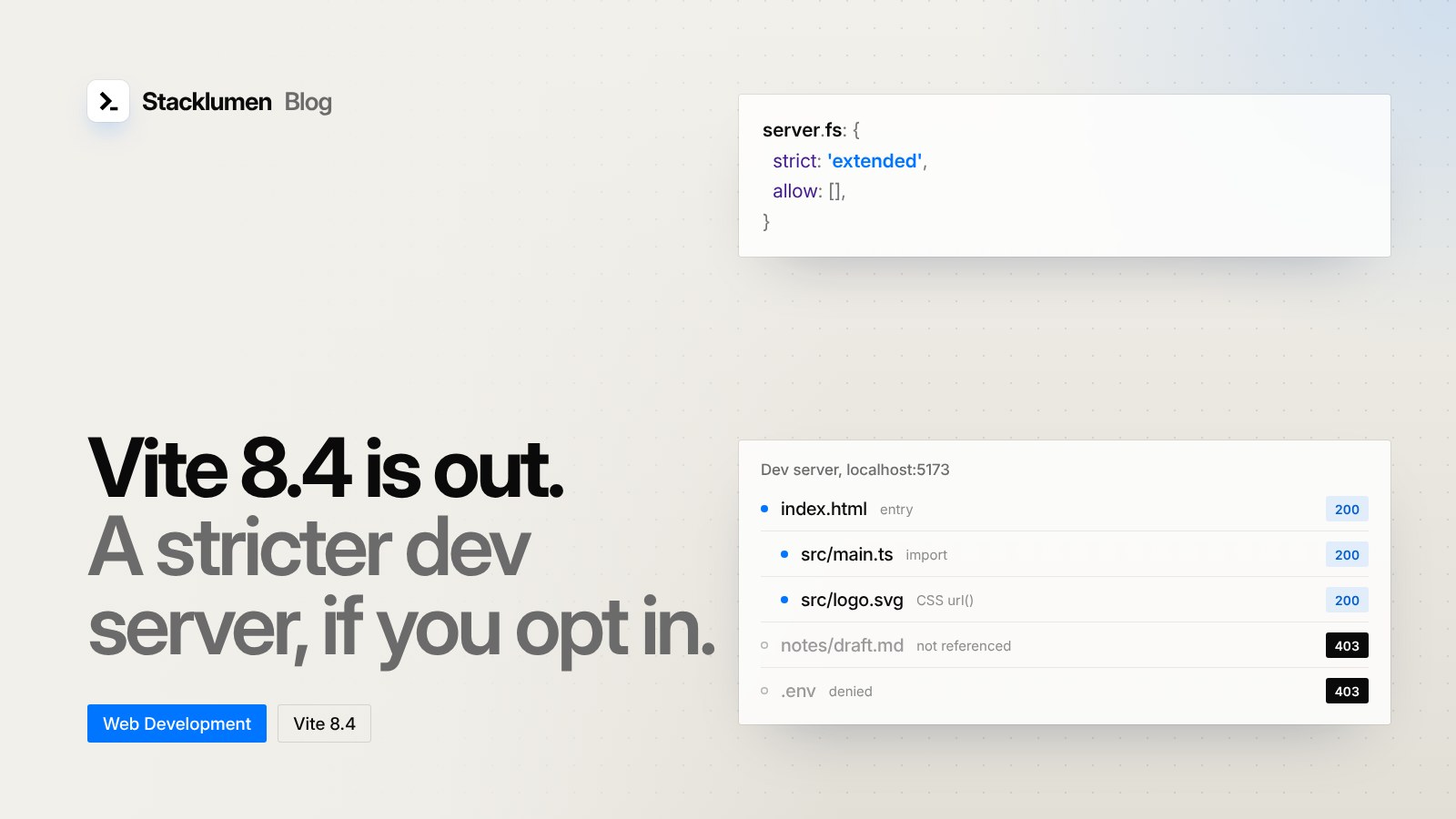
Vite 8.4 adds an allow-list approach that you turn on yourself. It has two parts:
server.fs.strictnow accepts the value'extended'. Vite's documentation says this applies the access checks to modules that plugins load as well.- Setting
server.fs.allowto an empty list as well means the server only serves files the entry point references, and the files those reference in turn.
Vite now counts more kinds of reference, such as url() in CSS, not only import. The documentation says a request for a file outside the allowed list that nothing allowed imports gets a 403 response. Vite's default deny list still applies, and it takes priority. It covers files such as .env, private keys and .npmrc.
The Vite team says it intends to make the allow-list approach the default in the next major version. If a plugin creates modules that point to assets in some other way than an import, its author can call this.environment.addSafeModule. That saves users from adding those files to server.fs.allow by hand.
Failed dynamic imports can now be retried
In July the HTML specification changed so that browsers may retry a dynamic import whose module fetch failed. Until then, a failed import kept failing. The Vite team lists Chrome 156 and later, Firefox 155 and later, and Safari Technology Preview 252 as supporting the change.
Vite 8.4 updates its preload helper to match. When a dynamic import runs again after a failure, the CSS for that chunk is fetched again too. In practice, a second click on something that loads code on demand can now work after the first attempt failed on a bad connection, in browsers that support the change.
Smaller changes
- Subpath imports in CSS
url(). Vite already supported Node.js subpath imports, but not inside CSSurl(). It now tries them there, and falls back to a plain hash URL if that fails. The team now recommends subpath imports overresolve.aliasor tsconfig paths, because Node.js and TypeScript both support them. - Duplicate process detection. If you start a second dev server for the same project with similar options while one is running, Vite stops with an error that names the address and process ID of the first one.
--bypass-lockskips the check. - WebAssembly source phase imports. You can now write
import source mod from './mod.wasm'to get aWebAssembly.Module. TypeScript 7.1, now in beta, will support the syntax. Once it is stable, the Vite team will recommend it over the Vite-specific.wasm?initfeature. - Bundled dev mode for server rendering. Vite calls this highly experimental. It is groundwork for frameworks built on Vite.
The full list of changes is in the Vite changelog.
What it means for your site
- If your project uses Vite, update to 8.4 when you next touch dependencies. The allow-list check only takes effect if you set it.
- If your development server is ever reachable from a network, for example with
--host, on a shared office network or in a cloud workspace, tryserver.fs.strict: 'extended'withserver.fs.allow: []on a branch. Look for 403 responses on assets your site really uses before you keep it. - Getting used to the allow-list approach now means less work when the next major version makes it the default.
- If your site loads parts of the page on demand, the retry change helps visitors on unreliable connections without any change to your code.