Every iPhone browser still runs on WebKit
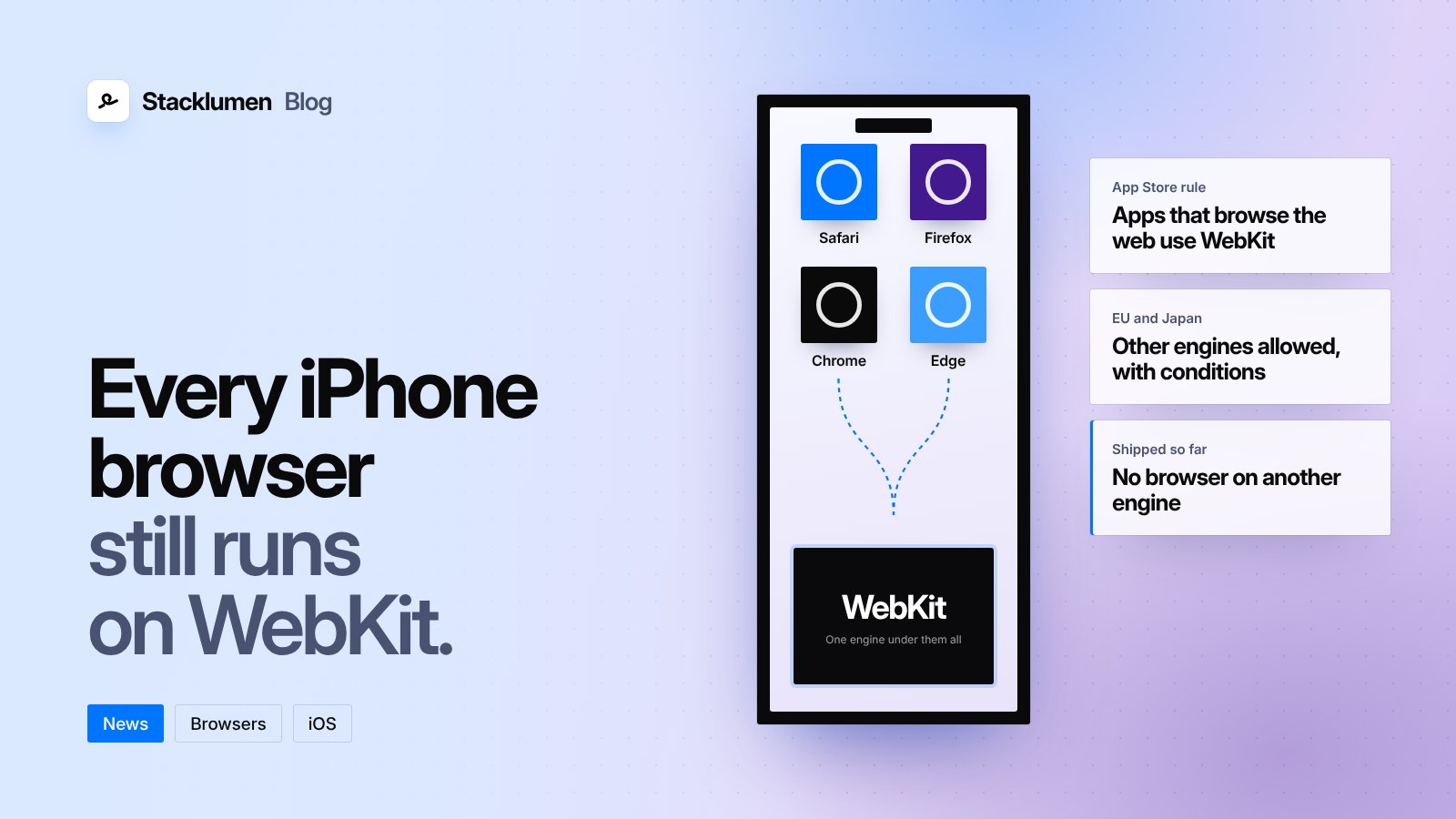
Mozilla says no browser on another engine has launched on iOS, even where EU and Japanese rules allow one. For your site, that means Safari's engine is the one every iPhone visitor uses.
 The Stacklumen team
On this page
Every browser on an iPhone still draws web pages with WebKit, the engine behind Safari. That is the main fact in a post Mozilla published on 20 November 2026, explaining why there is still no iPhone browser built on a different engine. For anyone who builds or runs websites, it settles a practical question: when you test for iPhone visitors, the engine you are testing is WebKit, whichever browser app they use.
What Mozilla says
Mozilla's post states that "Apple forces all browsers on iOS to be built on Apple's own browser engine." Firefox is built on Mozilla's own engine, Gecko, on other major platforms, including macOS. On iOS it is not.
Rules in the EU and Japan were meant to change this. Mozilla says that since 2024 the EU's Digital Markets Act has required Apple to let people choose a default browser, and that Apple then began allowing other browser engines in the EU under published conditions. Japan's new rules also require alternative engines, and Mozilla says Apple applied very similar conditions there.
Mozilla's view is that those conditions are unworkable. It says that nearly three years after the EU conditions, and almost a year after Japan's, no developer has launched a browser on iOS that uses an engine other than WebKit. One example it gives: it could not simply update the existing Firefox app to use Gecko. It would have to ship a second, separate app, and people would need to install it, move their bookmarks, passwords and history across, and switch over themselves. Mozilla says it will keep pressing for change.
What Apple's rules say
Apple's App Store Review Guidelines put the default plainly. Guideline 2.5.6 reads: "Apps that browse the web must use the appropriate WebKit framework and WebKit JavaScript." It adds that developers may apply for an entitlement to use an alternative engine, and links to the entitlements for the EU and Japan.
Apple's page on alternative browser engines sets out the conditions for the EU. The capability is available to EU users on devices running at least iOS 17.4 or iPadOS 18, and the app must be distributed only in the EU. An engine must pass at least 90 percent of the Web Platform Tests and 80 percent of Test262. It must block third-party cookies by default, and a browser app may not sync state, including cookies, with any other app, even one from the same developer, unless the person gives explicit permission. Developers request the entitlement from Apple and accept an addendum to their agreement.
Why this matters for websites
Browser names on an iPhone do not tell you which engine is running. A visitor using Chrome, Edge or Firefox on an iPhone is using WebKit underneath. So a CSS or JavaScript feature works on iPhones when WebKit supports it, not when the browser brand does elsewhere. A feature that ships in a desktop or Android browser first will not reach iPhone visitors until it ships in WebKit.
The same applies to bugs. A layout problem you see in Safari on an iPhone will usually show up in every other browser on that phone too, because they share the engine.
What it means for your site
- Treat Safari on an iPhone as the test for all iPhone visitors. Testing Chrome on an iPhone does not add a second engine.
- When you use a new web platform feature, check WebKit's support, not just Chromium's or Gecko's. Provide a fallback where WebKit has not shipped it yet.
- Do not plan around another engine arriving on iPhones soon. Mozilla's post says none has shipped in the EU or Japan, and it describes no launch date.
- If you serve EU visitors, nothing changes today. The rules allow other engines there, but no browser using one is available yet.