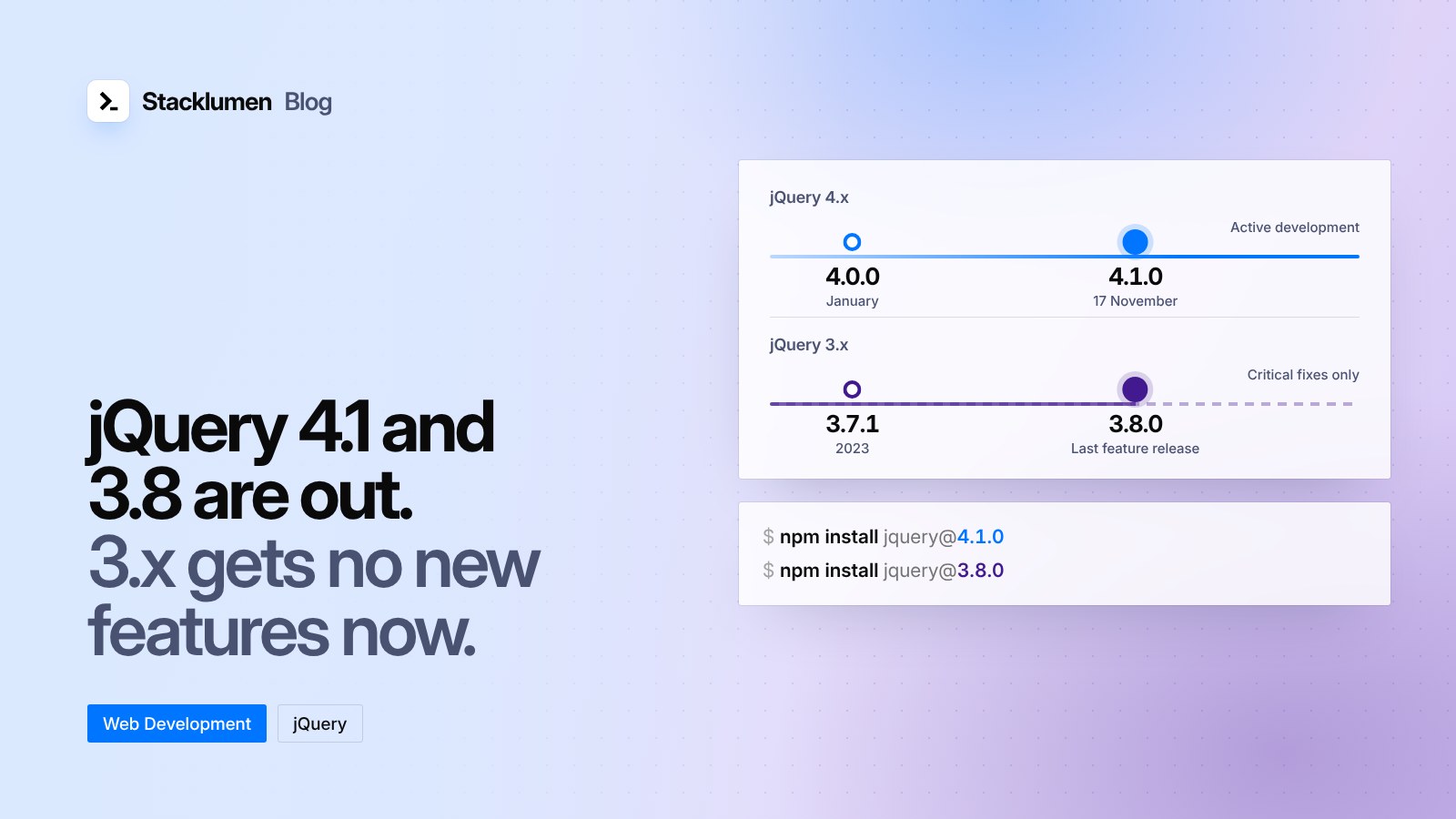
jQuery 4.1.0 and 3.8.0 are out, and 3.x gets no new features from here
jQuery 4.1.0 adds responseURL, custom element form support and a faster selector engine, while 3.8.0 is the last feature release of the 3.x line. Both fix a selector ReDoS problem.

On this page
The jQuery team released jQuery 4.1.0 and jQuery 3.8.0 on 17 November 2026. Version 4.1.0 is the first minor release of the 4.x line, which began with jQuery 4.0.0 in January. Version 3.8.0 is the last planned feature release of the 3.x line. From now on, 3.x will only get critical security and bug fixes.
If your sites still load jQuery, this release decides which line you should be on for the long term.
3.8.0 is a send-off, not a comeback
The jQuery team describes 3.8.0 as a way to ship fixes and improvements that had been waiting on the 3.x branch for several years. Many of them already shipped in jQuery 4.0.0. The team says plainly that active development happens on 4.x, and encourages everyone still on 3.x to move up.
To help, there is an upgrade guide for 4.0 and the jQuery Migrate plugin. The team says most users will be able to upgrade with minimal changes.
Changes in both releases
A few changes landed in both 4.1.0 and 3.8.0:
- A selector fix for a ReDoS problem. The regular expression jQuery used to match identifiers in selectors could backtrack for a very long time. A long chain of hex escapes followed by an invalid character, for example in an attribute selector, could hang the page. The pattern now follows the specification more closely and no longer has this problem.
- A new callback style for custom AJAX transports. Transports can now call their completion callback with a single object,
{ status, statusText, responses, headers }, instead of four positional arguments. This lets jQuery add new values later without depending on their order. - Fewer rare crashes in old browsers. The last strict document comparisons in the selector code were switched to loose ones, which avoids some rare errors in Internet Explorer and the legacy version of Edge.
What is new in 4.1.0
responseURLon jqXHR. Requests now report the final URL after any redirects the browser followed. It is only set when the transport can report it: modern browser XHR can, while IE 11 and the script and JSONP transports cannot.- Form-associated custom elements serialize. Custom elements registered with
formAssociated = truenow work with.serialize()and.serializeArray(). - CSS methods work in XML documents.
.css()and related methods now behave in non-XHTML XML documents, such as documents produced by XSLT. querySelectorAlleverywhere. jQuery no longer usesgetElementsByTagNameorgetElementsByClassNameinternally. The team saysquerySelectorAllis as fast or faster in current browsers, and the switch fixes several long-standing selector bugs.- A faster
jQuery.uniqueSort. Duplicate removal now takes linear time instead of quadratic time, with the same results and order.
The changelog also lists a workaround for a regular expression interpreter bug in Safari 27.
What is specific to 3.8.0
hidden="until-found"is kept. In 3.x,.attr( "hidden", "until-found" )used to overwrite the value becausehiddenwas treated as a plain boolean attribute. It is now set as written. jQuery 4.x already handled this.- New deprecations to prepare for 4.x. The
push,sortandsplicemethods on the jQuery prototype, andjQuery.expr[ ":" ]andjQuery.expr.filters, are now formally deprecated. These were removed in 4.0.0, so jQuery Migrate can now warn you about them before you upgrade. The release notes suggest[].push.call( $elems, elem )in place of$elems.push( elem ), andjQuery.expr.pseudosin place of the old selector extension points. - Backported fixes from 4.0.0, including correct sizes for table
<col>elements and support for self-removing scripts passed to.html().
How to get it
Both versions are on the jQuery CDN and download page and on npm as jquery@4.1.0 and jquery@3.8.0. Slim builds are available too. The team notes that other CDNs set their own schedules, so the new files may take some time to appear there.
What it means for your site
- Find out which version each site loads. Check your templates, theme files and
package.jsonfor jQuery and its version number. - On 4.x already? Update to 4.1.0. It is a minor release, and it includes the selector ReDoS fix.
- On 3.x? Update to 3.8.0 first. It picks up the same selector fix and adds deprecation warnings. Then run jQuery Migrate in development, fix what it reports, and plan the move to 4.x using the upgrade guide.
- Using custom AJAX transports or the jQuery prototype's array methods? Review those parts of your code, since they are the areas these releases change or deprecate.
- Test before you ship. Run through forms, menus and any scripts that build selectors from user input on a staging copy before updating the live site.