The W3C publishes first drafts for pointer-driven animations and Filter Effects Level 2
A new CSS draft would let animations follow the pointer across an element, and Filter Effects Level 2 sets out how backdrop-filter is drawn. Both are early drafts, not features to ship yet.

On 24 November 2026 the W3C CSS Working Group published two First Public Working Drafts. One, Pointer-driven Animations Module Level 1, is new. It describes CSS that ties an animation to where the pointer sits over an element. The other, Filter Effects Module Level 2, is the next level of the spec that defines filters, and it holds the backdrop-filter property.
A First Public Working Draft is an early stage. The W3C says publication at this stage does not imply endorsement by the W3C or its members, and that the document may be updated, replaced or dropped. Neither draft is something to ship on a live site today. Both are worth knowing about if you design or build interactive pages.
Pointer-driven animations
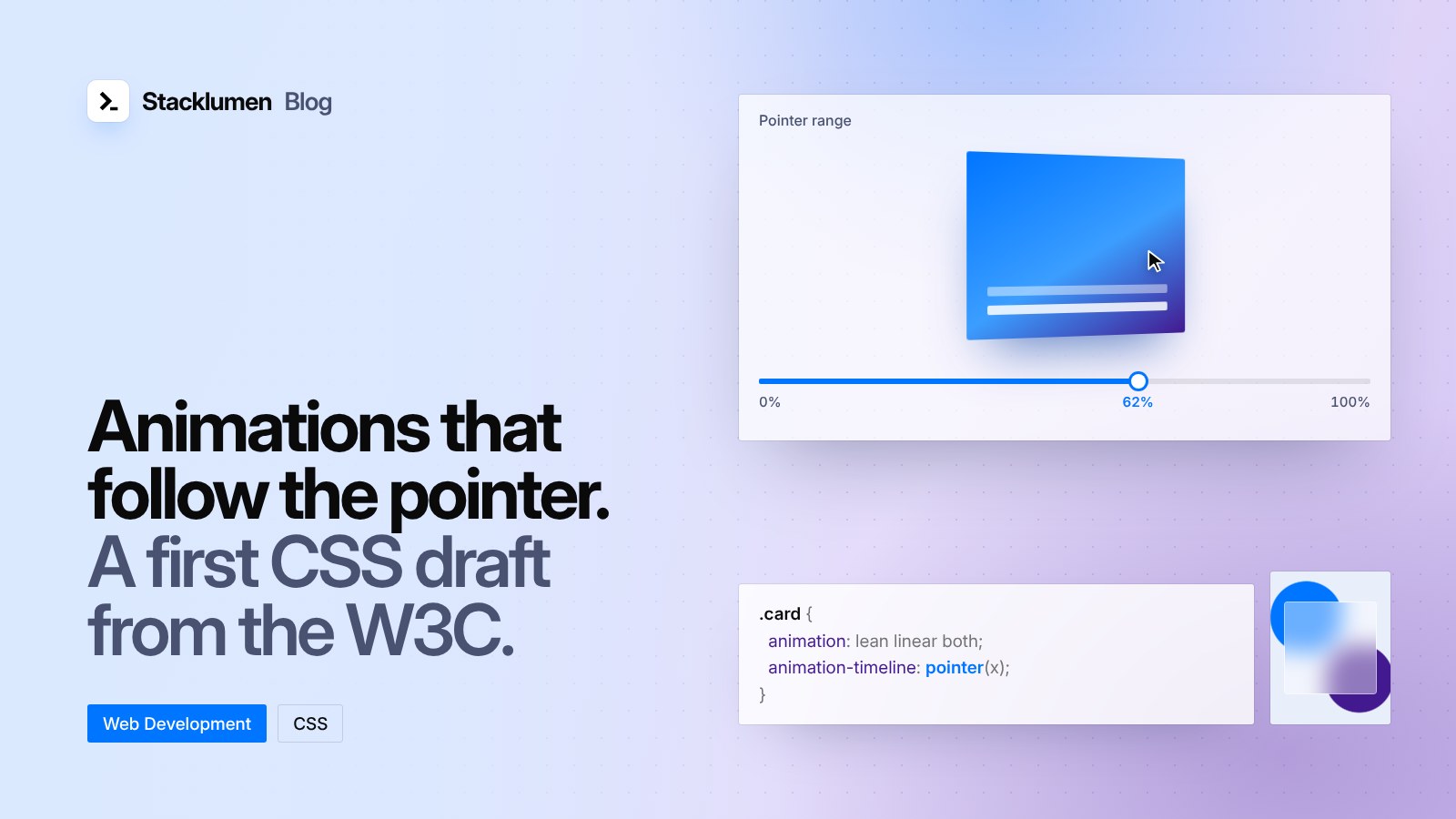
The draft defines "pointer progress timelines". Today a CSS animation usually runs over time, and scroll-driven animations run as the page scrolls. A pointer progress timeline runs as the pointer moves across an element instead. The draft says it was derived from the Scroll-driven Animations module and shares its concepts.
Progress is measured along one axis of an element's box. When the pointer is over the start edge, the animation is at 0%. When it is over the end edge, it is at 100%. In between, progress is the pointer's offset divided by the size of the box.
The draft proposes three ways to use this:
- The
pointer()function. It goes inanimation-timeline, asscroll()andview()do today. It takes an axis (block,inline,xory) and a source: the element itself (self), its nearest parent box (nearest) or the root element (root). - Named timelines. The properties
pointer-timeline-name,pointer-timeline-axisand thepointer-timelineshorthand let one element declare a timeline that other elements then use by name. - A JavaScript interface.
PointerTimelineextends the Web Animations API, so an animation created in script can be driven by the pointer too.
The draft also names ranges an animation can attach to, such as fill, fit, cover and contain. It adds an animation-range-center property, which sets where the 50% point of an animation sits rather than leaving it in the middle of the range. The draft notes that this property should later move into the CSS Animations and Web Animations specs.
In practice, this points to effects that often need JavaScript today, such as a card that tilts towards the pointer or a background that shifts as the pointer crosses a section, written as CSS instead. The draft's privacy and security sections say there are no known impacts. Some of the text is unfinished: one section still carries a note to insert diagrams.
Filter Effects Level 2
Filter effects process an element's rendering before it is drawn into the page. Blurring, changing colour intensity and warping are the examples the spec gives. Level 2 is written as a "delta", describing only what differs from Level 1.
Its main subject is backdrop-filter, which applies filters to whatever sits behind an element. It is the property behind frosted glass panels. The draft spells out how the effect is drawn: the content behind the element is copied, the filters are applied to that copy, it is clipped to the element's border box (including rounded corners), and the element is drawn on top. It also notes that the effect is only visible where the element is at least partly transparent.
The draft also defines a "Backdrop Root". This sets how far back up the page a backdrop filter can see. A Backdrop Root is formed by the root element and by elements with a filter, an opacity below 1, a mask or clip path, a backdrop filter, a blend mode other than normal, or a will-change that would create one. Transforms, z-index and fixed or sticky positioning do not form one. The draft gives the reasons: it avoids filters being applied twice to the same pixels, and avoids an extra rendering pass for every backdrop filter on a page.
The draft states that it does not yet have Working Group consensus, in particular on the definition of the Backdrop Root.
What it means for your site
- Nothing to change yet. Both are first drafts. Treat pointer-driven animation as something to watch, not something to use on client work.
- Keep JavaScript pointer effects for now. If a site already uses script for pointer-follow effects, there is no reason to rewrite them. When browsers start to ship
pointer(), the effect could move into CSS. - Check frosted panels against the Backdrop Root rules. If a
backdrop-filterpanel looks different than you expect, an ancestor with opacity below 1, a filter or a mask is a likely cause. The draft describes this cut-off in detail. - Respect motion preferences. Any pointer-driven effect should still honour
prefers-reduced-motion, as scroll-driven animations should. - Send feedback early. Both drafts ask for comments as issues in the CSS Working Group's GitHub repository. This is the stage where comments are most likely to shape the result.
Sources
- W3C: First Public Working Draft: Pointer-driven Animations Module Level 1
- W3C: Pointer-driven Animations Module Level 1, First Public Working Draft, 24 November 2026
- W3C: First Public Working Draft: Filter Effects Module Level 2
- W3C: Filter Effects Module Level 2, First Public Working Draft, 24 November 2026