Laravel fixes a denial of service flaw: update to 13.38.0 or 12.74.0
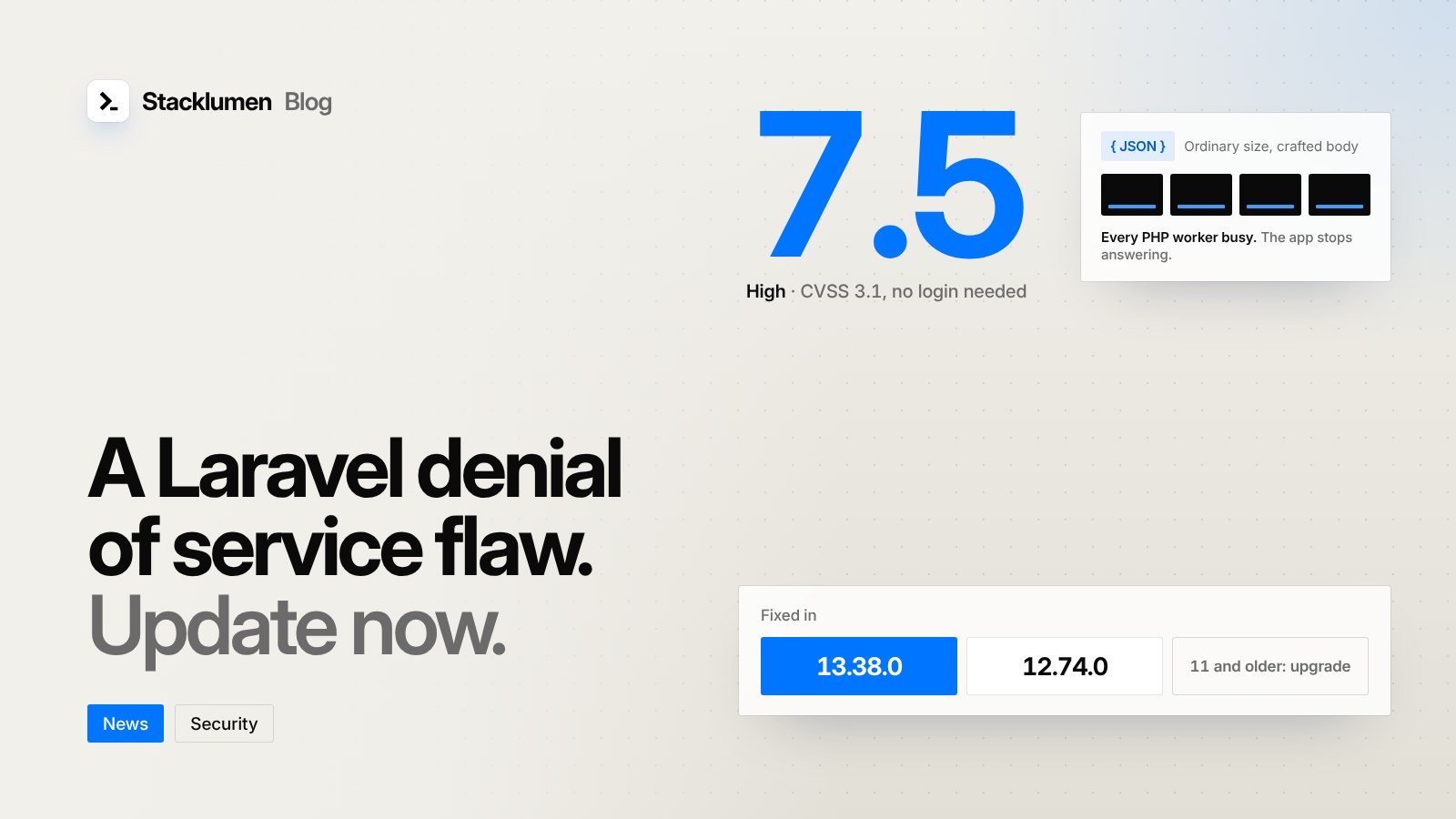
A crafted JSON request can tie up every PHP worker in a Laravel app and take it offline, with no login needed. Laravel 13.38.0 and 12.74.0 fix it.

On this page
Laravel published a security advisory on 23 November 2026 for a denial of service flaw in the framework. A crafted JSON request can make a Laravel application use too much CPU and memory while it handles the request. The fix is in Laravel 13.38.0 and 12.74.0.
What the flaw does
According to the advisory, the request does not need to be large. A JSON body of ordinary size, built in a particular way, is enough to make the application work far harder than it should.
An attacker does not need an account. The advisory says an unauthenticated attacker can send a small number of these requests at the same time, use up all of the application's PHP workers, and take the application offline. While every worker is busy, real visitors get no answer.
The flaw is tracked as GHSA-8h64-cpq2-9h2g. It has no CVE number. Laravel rates it High, with a CVSS 3.1 score of 7.5. The score reflects that it can be triggered over the network, needs no login and no user action, and affects availability only. The advisory does not describe any effect on data confidentiality or integrity.
Which versions are affected
The advisory covers the laravel/framework package:
- Laravel 13: versions before 13.38.0 are affected. Update to 13.38.0 or later.
- Laravel 12: versions before 12.74.0 are affected. Update to 12.74.0 or later.
The advisory lists no workaround, so updating is the fix.
What about older versions
Laravel's support policy gives each major version security fixes for two years. By that policy, Laravel 11 stopped getting security fixes on 12 March 2026, and Laravel 10 on 4 February 2025. The advisory names only 13.38.0 and 12.74.0 as patched, so there is no fixed release for 11 or older.
Laravel 12 receives security fixes until 24 February 2027, and Laravel 13 until 17 March 2028. If a site still runs Laravel 11 or older, the safe path is to upgrade to a supported major version.
How to update
For most projects this is a routine minor update, because Laravel's release notes say minor and patch releases should never contain breaking changes.
- Check your current version with
php artisan --version, or look forlaravel/frameworkincomposer.lock. - Run
composer update laravel/frameworkand confirm the new version is 13.38.0 or later, or 12.74.0 or later. - Run your tests, then deploy as you normally would.
If your composer.json pins the framework to an exact older version, loosen the constraint first, for example to ^13.0 or ^12.0, which is the form Laravel recommends.
What it means for your site
- If you run a Laravel app or API that accepts JSON from the public internet, treat this as urgent. No login is needed to trigger it.
- Update to 13.38.0 or 12.74.0 or later, and redeploy. A dependency update only protects you once the new code is live.
- If you look after client sites built on Laravel, check each one. A site that is rarely touched is the one most likely to be on an old release.
- If any site is on Laravel 11 or older, plan the upgrade now. It will not receive this fix.
- Rate limits and a request size cap at your proxy are good practice, but the advisory says the requests are of ordinary size and only a small number are needed, so they are not a substitute for the update.