Drupal fixes a highly critical installer flaw that is being exploited: update now
Drupal core 11.4.13, 11.3.22 and 10.6.22 fix a flaw that lets an attacker misuse the installer to take over a site, and Drupal has a report of it being exploited. Update, then block install.php.

On this page
Drupal released security updates for every supported branch of Drupal core on 18 November 2026. The most serious flaw is rated highly critical and lets an attacker misuse the Drupal installer to take over a site. The Drupal Security Team has since received a report that it was exploited on live sites. If you run or look after a Drupal site, update it now.
What was fixed
The release came with two advisories.
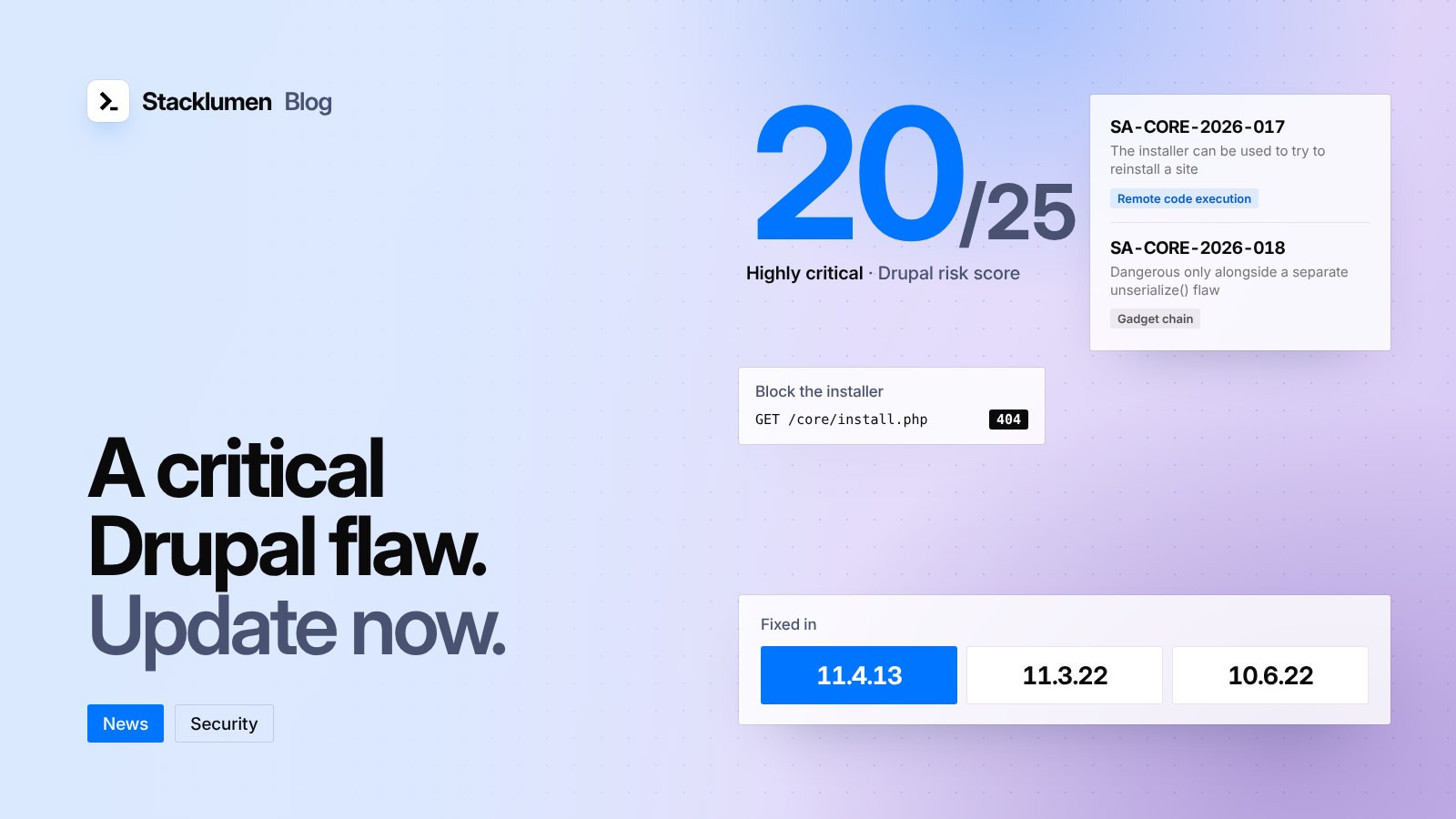
SA-CORE-2026-017, remote code execution. Drupal ships an installer, install.php, that sets up a new site. The advisory says that under specific conditions an attacker can use the installer to try to reinstall Drupal, which can lead to site takeover or remote code execution. It is tracked as CVE-2026-132165 and scores 20 out of 25 on Drupal's risk scale, which Drupal rates highly critical. The advisory notes that some, but not all, exploit paths are blocked if the web server cannot write to or change permissions on settings.php.
SA-CORE-2026-018, gadget chain. This is a set of code paths that becomes dangerous only if a site also has a separate flaw that passes untrusted data to PHP's unserialize(). Drupal says it is not directly exploitable on its own. It is tracked as CVE-2026-132166 and rated moderately critical, 14 out of 25.
Exploited on live sites
The remote code execution advisory carries an update: the Security Team "has received a report this was exploited on live sites as early as 2026-11-19 19:00 UTC". That is the day after the fix was released.
Drupal had warned site owners two days ahead. Its public service announcement of 16 November said the release would land between 17:00 and 21:00 UTC on 18 November, that at least one issue could be exploited by anonymous users, and that exploits "might be developed within hours or days".
Which versions to install
Both advisories are fixed in the same releases:
- Drupal 11.4.x: update to 11.4.13
- Drupal 11.3.x: update to 11.3.22
- Drupal 10.6.x: update to 10.6.22
Drupal 11.2.x and earlier, Drupal 10.5.x and earlier, and Drupal 8 and 9 are end of life and get no security fixes. The announcement also listed the Drupal 12.0.0-beta3 and 11.5.0-beta1 pre-releases as affected, with new beta and release candidate versions to follow.
Sites that use the Drupal Steward service are protected against known attack paths for this issue, according to the advisory. Drupal still asks those sites to upgrade soon.
Lock down the installer
Both the advisory and Drupal's own documentation recommend blocking access to the installer once a site is installed, whether or not you have upgraded yet. The documentation gives three ways to do it:
- Web server configuration (recommended). On Apache, deny
/core/install.phpin the server configuration, not in.htaccess, which the page warns causes a 500 error. On nginx, add a prefixlocation ^~ /core/install.phpblock that returns 404. Drupal advises against an exact-match block, because some setups still pass/core/install.php/footo PHP. .htaccess(Apache only). For shared hosting, add a<Files "install.php">rule to the web root's.htaccess. Composer overwrites that file, so the page suggests adding the lines through the scaffold settings incomposer.json.- Delete the file. Remove
core/install.php. Composer restores it on every install or update, so the page suggests a script that removes it again afterwards.
Be careful not to block update.php, which is a separate script you still need. Then check the block works: request /core/install.php, /install.php and /core/install.php/foo. Each should answer 403 or 404. A 200 means the installer is still reachable.
What it means for your site
- If you or a client run Drupal 10 or 11, update today to 11.4.13, 11.3.22 or 10.6.22.
- Block
install.phpat the web server as well, and confirm it with a quick request. - If a site is on an end-of-life version, apply the installer block now and plan the upgrade. It will not receive this fix.
- Because exploitation has been reported, look closely at any Drupal site that was still unpatched after 19 November.
- Ignore unsolicited emails claiming to describe Drupal core security issues. Drupal's announcement warns against acting on them.