1,606 new domain endings are up for review: comments and objections close 16 March 2027
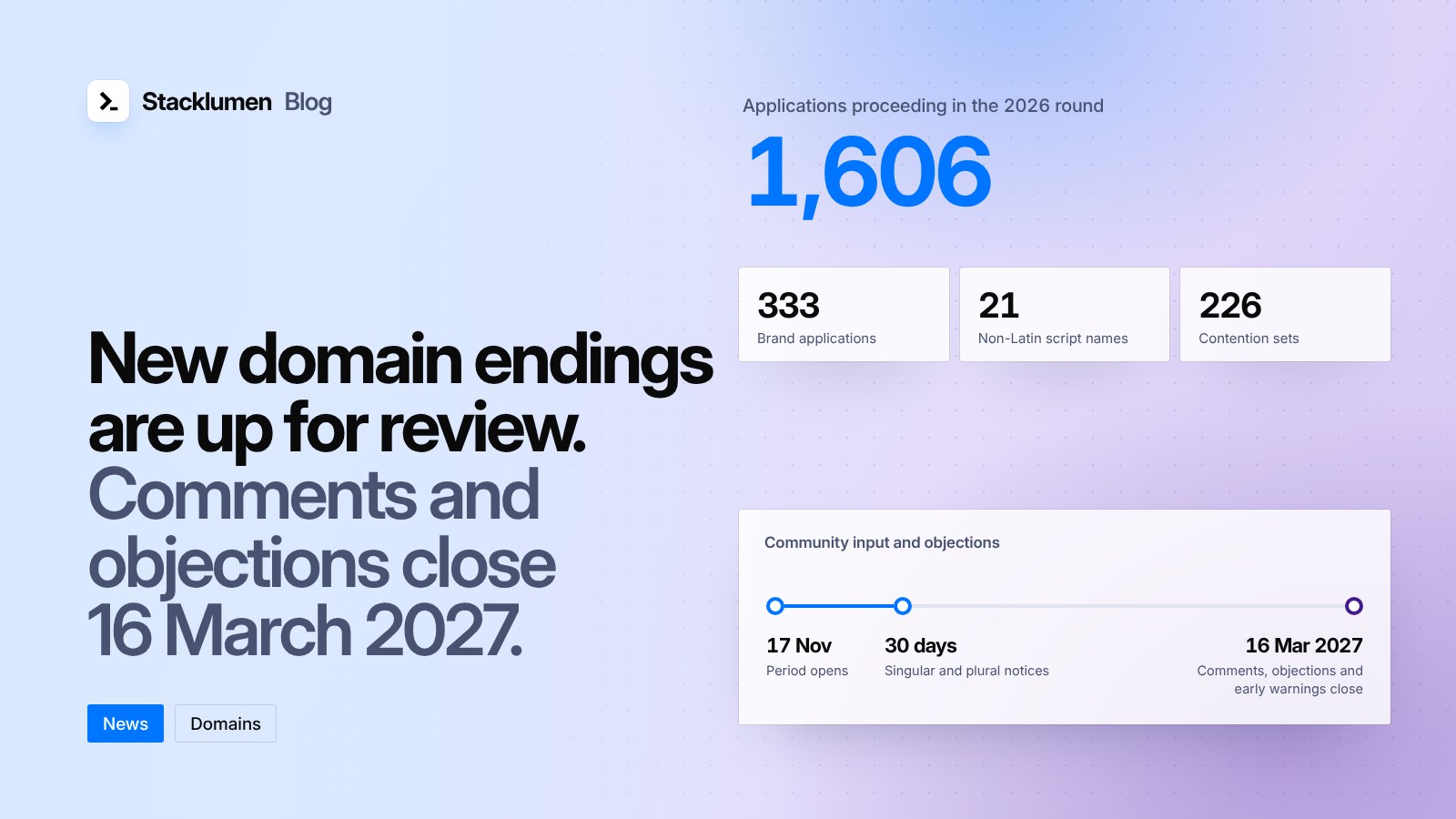
ICANN has confirmed the 1,606 applications going ahead in its 2026 round of new top-level domains. Anyone can now comment, and rights holders and others can object, until 16 March 2027.

On this page
ICANN, the body that coordinates internet domain names, has published the final list of applications for new top-level domains in its 2026 round. A top-level domain is the part of an address after the last dot, such as .com or .shop. String Confirmation Day was 17 November 2026, and it opens a public period for comments and objections that runs until 16 March 2027.
What ICANN published
ICANN says 1,606 applications are going ahead in the round, with nine withdrawn since the applications were first revealed. Applicants who were allowed to switch to a different string used that option on 152 applications. That cut the number of contention sets, groups of applications for the same or similar strings, from 263 to 226. The share of applications in contention fell from 55 percent to 44 percent.
By type, the round includes 333 brand applications, 16 community-based applications, 15 self-identified geographic names, 21 applications for internationalized domain names in non-Latin scripts, and eight variant applications. By region, 864 applications came from North America, 504 from Europe, 211 from Asia, Australia and the Pacific, 16 from Africa and 11 from Latin America and the Caribbean.
The applying organisations and the public parts of their applications are listed on ICANN's Application Publication and Statistics website, along with the updated contention sets.
How to comment or object
ICANN describes four ways to give input, each with its own rules and deadlines:
- Application comments. Anyone can read and post comments on the Application Comment Forum. Posting needs an ICANN Account. Evaluators will only consider comments submitted before 16 March 2027 or in other official comment windows.
- Objections. These are filed with dispute resolution service providers, not with ICANN, by 16 March 2027. There are four grounds: string confusion, legal rights, limited public interest and community. Each ground has its own rules on who may file. The Applicant Guidebook says rights holders may file a legal rights objection and anyone may file a limited public interest objection. Objectors pay a filing fee set by the provider, and ICANN's guidebook says it is not refunded.
- Singular and plural notifications. Anyone can tell ICANN, within 30 days of 17 November, that two applied-for strings are the singular and plural of the same word in the same language. The same applies when a string is the singular or plural of an existing top-level domain or a blocked name.
- Government early warnings. Members and observers of ICANN's Governmental Advisory Committee can flag an application as sensitive by 16 March 2027.
What happens next
Every confirmed application now goes through string evaluation, which ICANN says is meant to make sure new domains do not harm the stability or security of the domain name system. It covers geographic names, string similarity, name collision and a safeguard assessment.
Applicants also have until 23:59 UTC on 27 November 2026 to withdraw and receive a 65 percent refund of the evaluation fee. ICANN says it will announce dates later for the prioritization draw, the string evaluation results and the next evaluation stages. It has not given a date for when any of the new endings will be available to register.
What it means for your site
- Nothing changes for your current domain. This round is about adding new endings. It does not affect addresses that already exist.
- Check the list for your brand. If you or a client hold a trademark, search the published applications for strings that match or closely resemble it. A legal rights objection has to be filed by 16 March 2027.
- Watch the 30-day window. If you notice a singular or plural clash, that notification has a much shorter deadline than the other routes.
- Don't plan a launch around a new ending yet. No registration dates have been set, and strings in contention may not all go ahead.
- Expect more unfamiliar endings in links and email. When new domains do launch, forms that check email addresses or link formats should accept any valid top-level domain, not a fixed list.
Sources
- ICANN: ICANN Confirms 2026 Round Applications; Input and Objections Period Begins
- ICANN: Application Publication and Statistics, 2026 Round
- ICANN: Application Comment Forum
- ICANN: 2026 Round Applicant Guidebook, Module 4: Community Input, Objections and Appeals
- ICANN: Singular/Plural Notifications
- ICANN: 2026 Round String Evaluation