Nuxt 4.7 fixes three security flaws: update and purge your cache
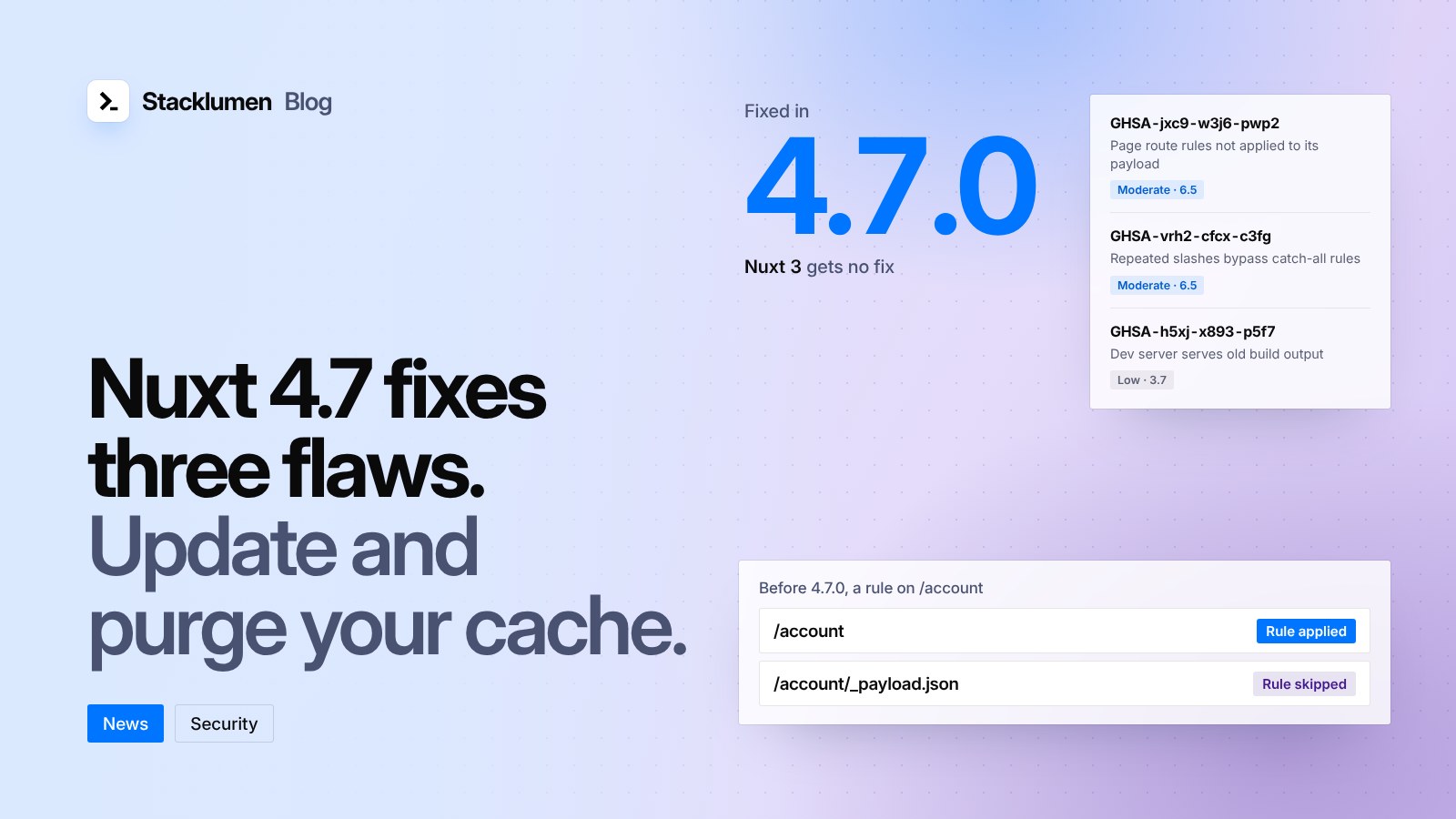
Nuxt 4.7.0 fixes two moderate flaws that let requests skip a page's route rules, and a low-severity dev server flaw. Nuxt 3 gets no fix.

On this page
Nuxt 4.7.0 came out on 23 November 2026. Alongside new features, it fixes three security flaws, and the Nuxt team recommends upgrading. The three advisories were published on GitHub on 24 November. Two are rated moderate and one is rated low. If you run a Nuxt site, this post covers what each flaw does, who is affected and what to do.
The payload flaw
The most serious for most sites is GHSA-jxc9-w3j6-pwp2, rated moderate with a CVSS score of 6.5.
Nuxt lets you set route rules for a page, such as a redirect, a proxy, extra headers, ssr: false or a cache exclusion. The advisory says those rules were not applied to the page's payload URL, the _payload.json file that holds the data the page fetched on the server. If a catch-all rule turned on caching, a request for the payload URL fell back to that rule and still rendered the page.
The advisory lists what that can mean:
- A redirect or proxy rule used to keep people out of a page can be bypassed by asking for the payload URL directly, which exposes data fetched on the server.
- On sites that use incremental static regeneration, cache exclusions can be bypassed, so a shared cache may store one user's page data and serve it to others.
- Security headers set for the page are missing from the payload response.
Rules written as a wildcard that already covers the payload URL, such as '/admin/**', are not affected. The advisory also says that turning off payload extraction does not protect affected versions.
The repeated slash flaw
GHSA-vrh2-cfcx-c3fg is also rated moderate, at 6.5. It is an incomplete fix for an earlier advisory. Nuxt matched route rules against the request path with repeated slashes left in, while the page router still sent such paths to a catch-all page. A request with a doubled slash, or a leading encoded slash, could render the page without the route rules meant for it. The advisory says an unauthenticated attacker can use this to bypass rules that protect paths served by a catch-all page route. Whether protected content is exposed depends on how the page reads the route parameter.
The dev server flaw
GHSA-h5xj-x893-p5f7 is rated low, at 3.7, and affects development only. The dev server started by nuxt dev served the server bundles left behind by an earlier nuxt build. Those bundles contain the resolved runtime config, so private values could be read by anyone who can reach a dev server that has been exposed to a network. Values left empty in nuxt.config and supplied through NUXT_* environment variables are not exposed.
Who is affected
The two moderate flaws affect nuxt from 3.0.0 up to versions before 4.7.0, through the nuxt package itself on older releases and through @nuxt/nitro-server on newer ones. The dev server flaw affects @nuxt/vite-builder before 4.7.0. Version 4.7.0 fixes all three.
Nuxt 3 has reached end of life and will not receive a fix. Sites still on Nuxt 3 need to move to Nuxt 4 to get these fixes.
How to update
The release notes recommend running npx nuxt upgrade --dedupe, which refreshes the lockfile and pulls in the latest dependencies. Nuxt 4.7 also requires vue 3.5.46 or later, and Nuxt DevTools is no longer installed with Nuxt, so add @nuxt/devtools to your dev dependencies if you use it.
If you cannot upgrade straight away, the advisories list workarounds:
- For the payload flaw, add a wildcard rule with the same value next to each exact path rule, for example
'/account/**'alongside'/account'. The advisory describes enforcing access in server middleware, route middleware or the upstream API as more robust. - For the repeated slash flaw, add server middleware that returns a 404 for paths containing a doubled or encoded slash, or put the site behind a reverse proxy or CDN that merges repeated slashes.
- For the dev server flaw, do not expose the dev server to untrusted networks, and delete
.output,.nuxt/prerenderandnode_modules/.cache/nuxtbefore runningnuxt dev.
What it means for your site
- If your site or your client's site runs on Nuxt 4, upgrade to 4.7.0 or later and redeploy.
- If you use
cache,swrorisrroute rules on pages that show user-specific data, purge your CDN or edge cache after upgrading. The release notes say any cached_payload.jsonmay hold that data. - If you relied on route rules to keep people out of a page, check that access is also enforced on the server, not only by a rule.
- If someone outside your team could have reached a dev server, rotate any credentials set through
runtimeConfig, as the advisory recommends. - If a site is still on Nuxt 3, plan its move to Nuxt 4.