Google expands its advice on 404 errors and sitemaps
Google has gathered its guidance on missing pages and sitemaps into its Search documentation: most 404s can be left alone, they don't use up crawl budget, and nested sitemap index files are not supported.
 The Stacklumen team
On this page
Google has updated its Search documentation on two everyday parts of running a site: pages that no longer exist, and sitemaps. On 27 November it expanded its guidance on 404 errors, and moved some older sitemap advice from its first blog posts into the main documentation. None of this is a new rule. It is Google writing down, in one place, how it already handles these cases.
What changed
Google's documentation updates page lists two changes on 27 November 2026.
The first expands the crawling errors troubleshooting guide with a video and new guidance on 404 errors: when to ignore them, how 404 URLs affect crawl budget, updating sitemaps for removed URLs, and mistakes to avoid. Google says this brings together 404 guidance that used to sit in the Search Console Help Center, and that the old help page now redirects to it.
The second moves guidance that is still accurate from Google's oldest Search Central blog posts, from 2005, into the sitemaps documentation. Google gives two examples: nested sitemap index files are not supported, and HTML sitemaps cannot be submitted in Search Console.
When a 404 is fine
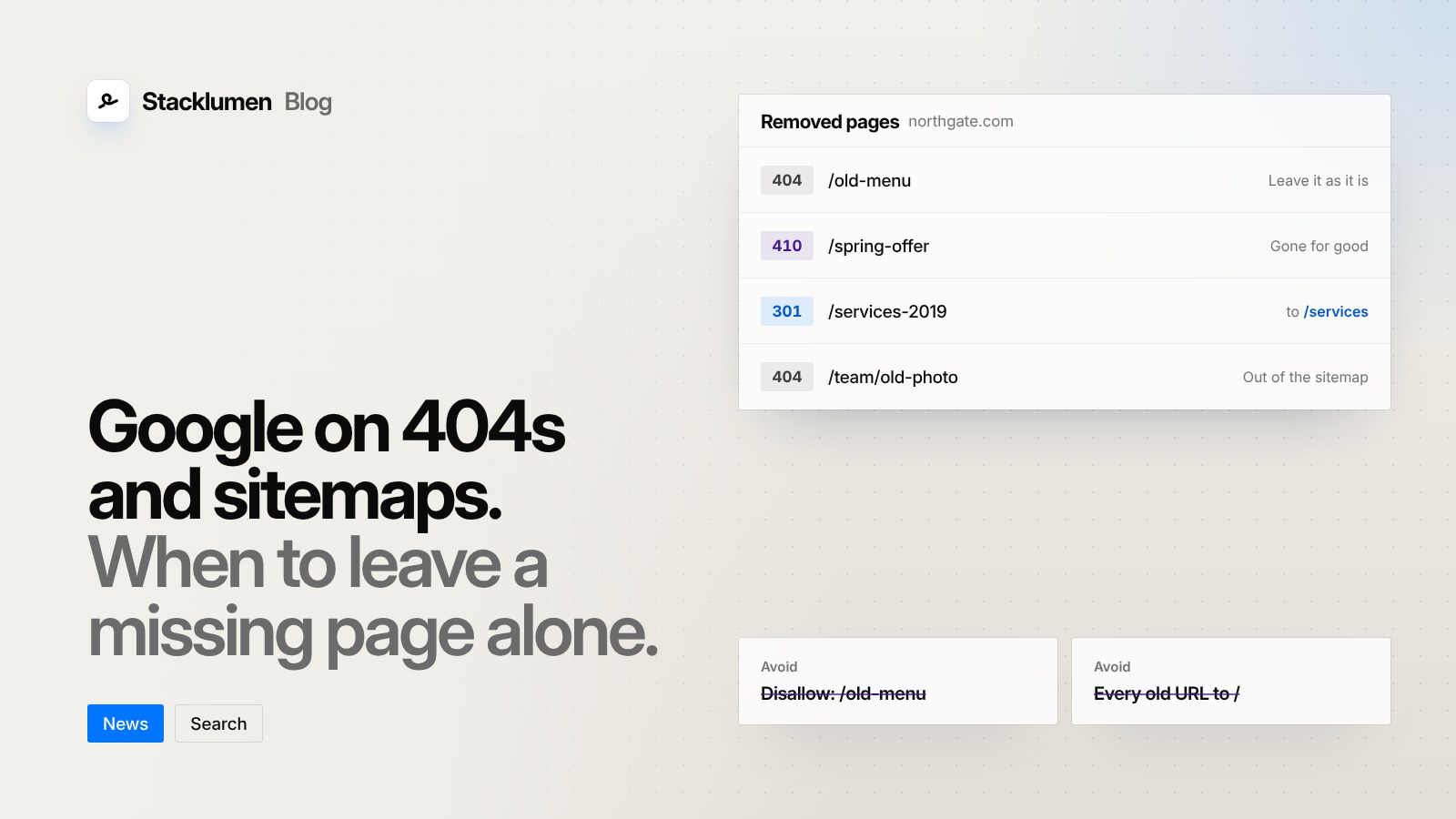
The guide is direct: "In most cases, 404 errors are a normal part of how the web works." For URLs that never existed, such as a mistyped link from another site, Google says you can generally ignore the errors and leave those URLs returning 404.
There is one exception. If a commonly mistyped URL gets meaningful traffic and clearly means one of your real pages, redirect it to that page. Beyond that, Google treats it as a decision about your visitors and your business, for example whether people still reach an old URL from links elsewhere.
404s do not use up crawl budget
A common worry is that a long list of 404s in Search Console hurts how often Google crawls the rest of a site. The guide says otherwise: 404 and 410 status codes do not lower a site's crawl capacity, and 404 URLs already listed in Search Console do not meaningfully consume crawl budget. Server errors (5xx) and 429 "too many requests" responses are different. Google reads them as a sign the server is overloaded, and crawls less.
404 or 410
For indexing, Google treats 404 and 410 the same way. The difference is in crawling: Google may keep checking a removed URL now and then, and returning 410 generally leads to less frequent crawling of it.
Two mistakes to avoid
Blocking removed pages in robots.txt. Google has to crawl a removed URL to see its 404 or 410 status. If robots.txt blocks the URL, Google cannot see the status code.
Sending every missing page to the home page. Redirecting URLs that no longer exist to an unrelated page, or showing placeholder content, can confuse people and search engines. Google treats these as soft 404 errors. Only redirect to a page that genuinely replaces the old one.
The same applies to custom error pages. A friendly "page not found" page is fine, but the server must still answer with a 404 status. A page that says the content is missing while answering 200 (success) is a soft 404, and Google leaves it out of Search.
The sitemap reminders
The sitemaps documentation now states plainly what the old blog posts said:
- Nested sitemap index files, where one index file points to another index file, are not supported.
- An HTML sitemap is not a format you can submit in Search Console. It can still help visitors, but it is not a substitute for an XML sitemap.
- A single sitemap is limited to 50MB uncompressed or 50,000 URLs. A sitemap index file can list up to 50,000 sitemaps, and you can submit up to 500 index files per site in Search Console.
- Use full, absolute URLs. Google ignores the priority and changefreq values, and uses lastmod only when it is accurate.
The 404 guide adds one more: if a removed URL is still listed in your sitemap, take it out.
What it means for your site
- Don't chase every 404 in Search Console. Check whether any of them are pages people still try to reach from real links, and redirect only those to a true replacement.
- Use 410 for content you have removed on purpose and will not bring back, if you want Google to check it less often.
- Make sure your custom "page not found" page answers with a 404 status, not 200.
- Don't block removed URLs in robots.txt, and don't redirect them all to the home page.
- When you remove pages, update your sitemap at the same time.
- If you split a large sitemap, keep it to one level: one index file pointing to sitemaps, not to other index files.