Core Web Vitals will start counting soft navigations, planned for May 2027
Chrome now publishes experimental Core Web Vitals that measure each view of a site that changes pages with JavaScript, and plans to make them official in May 2027. Most sites will see no change, but single-page apps should check their numbers now.

On this page
Chrome is preparing to change how Core Web Vitals are measured for sites that change pages with JavaScript. Experimental versions of LCP, INP and CLS that include "soft navigations" are now published in the Chrome User Experience Report (CrUX). On 11 November, Chrome added soft navigation data for First Contentful Paint (FCP) and navigation types to the CrUX APIs. Chrome says it aims to make these metrics official in May 2027, and that Search Console will then switch to the new data.
What a soft navigation is
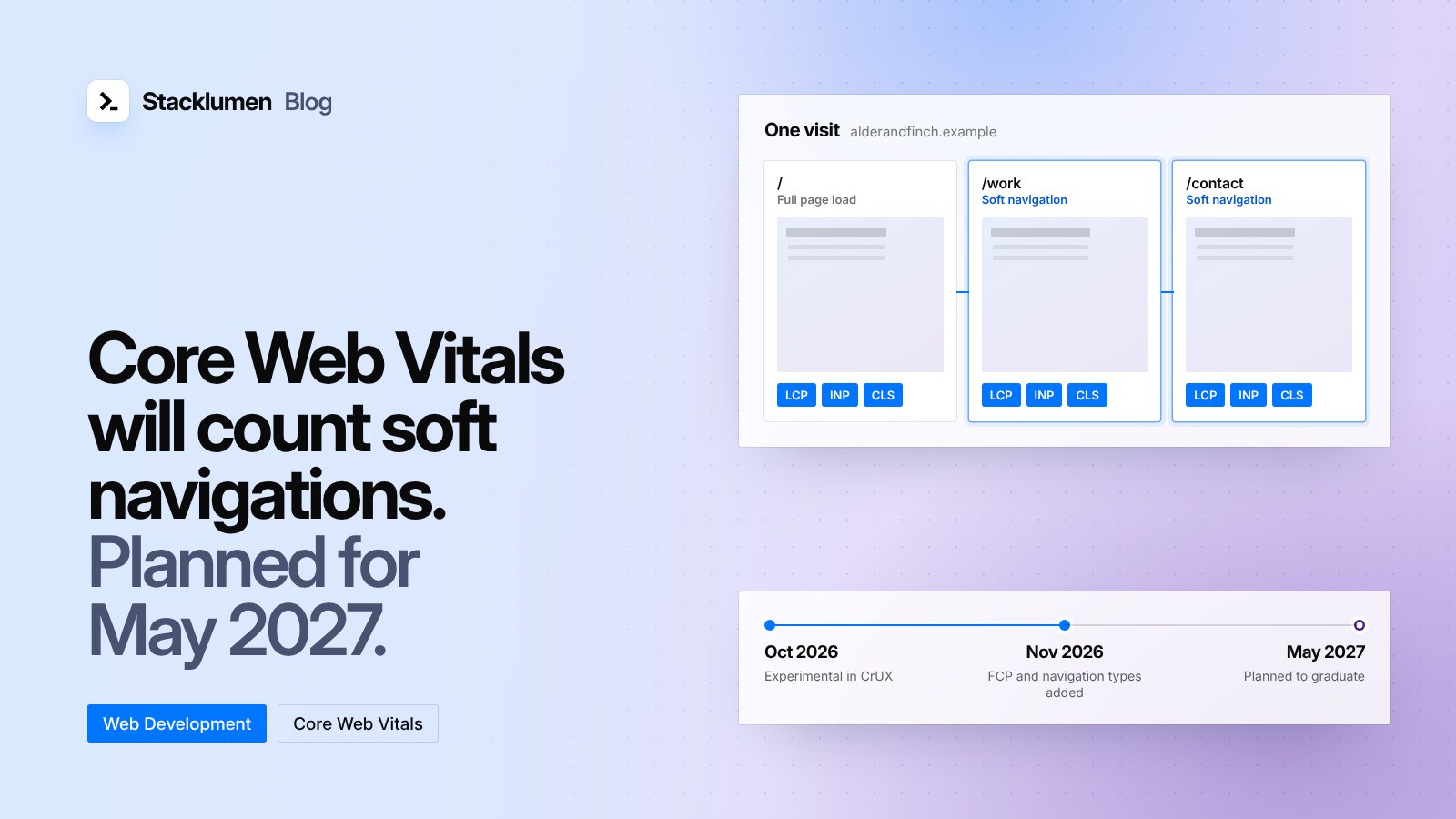
Most websites load a new HTML document each time a visitor clicks a link. A single-page application (SPA) works differently: it swaps the content and updates the address with JavaScript, without a full reload. Chrome calls this a soft navigation.
Until now, Core Web Vitals treated only the first page a visitor landed on as a load. Every view after it, on a site built this way, was not measured as a page of its own. Chrome counts a soft navigation when three things happen: a user action starts it, the visible URL changes, and the interaction leads to a visible paint. Chrome notes that this definition can produce some false positives and false negatives.
The Soft Navigations API that detects these changes is enabled by default from Chrome 151.
What is in CrUX now
Since 13 October, CrUX has published three experimental metrics that blend soft and hard navigations:
experimental_largest_contentful_paint_with_softnavsexperimental_interaction_to_next_paint_with_softnavsexperimental_cumulative_layout_shift_with_softnavs
They are available in the CrUX BigQuery dataset, the CrUX API and the CrUX History API, and the CrUX Vis tool shows them for any URL or origin. The release published on 11 November added soft navigation FCP and navigation types to the APIs. Chrome says this data reaches BigQuery the following month.
Chrome's stable Core Web Vitals scores do not change while the experimental versions are evaluated alongside them.
Who will see a difference
Chrome says the experimental metrics "will look identical or nearly identical" to the current ones for most sites, including many SPAs. Around 70% of origins have fewer than 5% of their page views as soft navigations. A site that loads a new page on every click should see no change.
The sites most affected are those that rely on soft navigations for most of their traffic. Chrome puts these at 7.0% of origins on Android and 10.6% on desktop. For them, Chrome expects:
- LCP to improve, because later views reuse code and assets already downloaded. Chrome stresses this reflects faster follow-up clicks, not SPAs being faster than multi-page sites overall.
- INP to improve, because responsiveness is measured per view rather than across the whole visit. SPA-heavy sites still trail multi-page sites, and heavy JavaScript during route changes can still cause INP problems.
- CLS to improve, because layout shifts are scored per view.
Soft navigation data is also reported under the URL the visitor moved to, not only the landing page. That makes it easier to find which view has a problem.
How to measure it yourself
The web-vitals JavaScript library supports soft navigations from version 6.0.0. Passing {reportSoftNavs: true} to onLCP, onINP, onCLS, onFCP and onTTFB reports each soft navigation separately. TTFB is reported as 0 for them. Chrome recommends segmenting results by navigationType, because a view reached by a soft navigation can measure differently from a cold load of the same URL.
Support is limited to Chromium-based browsers. If you use a real user monitoring service, check whether it supports soft navigations.
The timeline
- October 2026: experimental LCP, INP and CLS with soft navigations added to CrUX.
- November 2026: soft navigation FCP and navigation types added to the CrUX APIs.
- May 2027: Chrome aims to graduate the metrics from experimental, "subject to feedback". Search Console will then use the new data.
Chrome is collecting feedback through the web-vitals-feedback group and the soft navigations specification repository.
What it means for your site
- If your site loads a new page on every click, as most marketing and brochure sites do, Chrome expects no change to your scores.
- If your site or app changes views with JavaScript, open CrUX Vis and compare the experimental metrics with your current ones before May 2027, so a change in Search Console does not come as a surprise.
- Look at INP first on JavaScript-heavy sites. It is the metric Chrome says can still suffer from heavy work during route changes.
- Use the per-URL data to find the specific views that are slow or shift, rather than judging the site by its landing page alone.