Google's November 2026 core update is rolling out
Google began rolling out its November 2026 core update on 10 November, and it may take up to two weeks. Here is what Google's guidance says to check, and when.

On this page
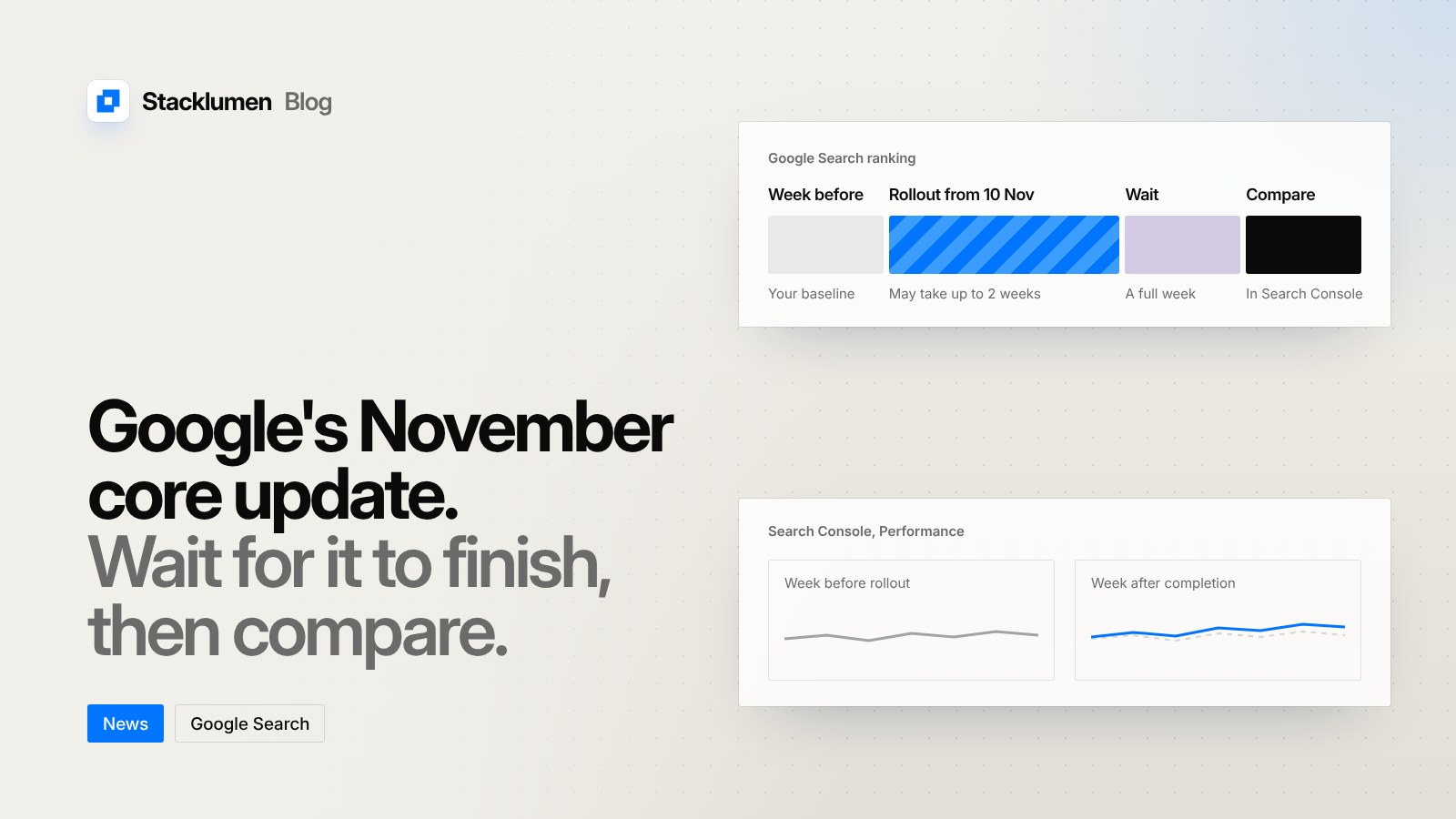
Google has started rolling out its November 2026 core update. The update began on 10 November 2026 at 10:06 Pacific time, according to the Google Search Status Dashboard. Google says it "applies globally and to all languages" and that "the rollout may take up to 2 weeks to complete."
If you run a website, or look after sites for clients, you may see search traffic move over the next couple of weeks. Here is what a core update is, and what Google's own guidance says to do about it.
What a core update is
Google describes core updates as "significant, broad changes to our search algorithms and systems." It makes them several times a year. They are not aimed at particular sites. Google says core updates "don't target specific sites or individual web pages", and that their purpose is to keep search results helpful and reliable overall.
The dashboard lists this as the third core update of 2026, after the March and May core updates. It follows spam updates in June, August and September.
Google also says most sites do not need to do anything when a core update lands.
Wait for the rollout to finish
Rankings can move up and down while an update is still rolling out. Google's guidance is to check the Search Status Dashboard first and confirm the update has finished before you draw any conclusions.
Once it has finished, Google asks you to wait "at least a full week after a core update completes before analyzing your site in Search Console." Then compare that week with the week before the rollout began. For this update, the week before is the one ending 10 November.
Google suggests checking Web Search, Google Images, Video and News separately in Search Console, so you can see where any change happened.
If traffic has dropped
Google's guidance draws a line between small and large changes. A small drop does not call for a drastic response. A large drop that lasts is a reason to review the site as a whole, not just a few pages.
Google warns against "quick fix" changes. It asks site owners to focus on improvements that help visitors over the long term. Its guide to creating helpful content includes a set of self-assessment questions, such as:
- "Does the content provide original information, reporting, research, or analysis?"
- "Is this the sort of page you'd want to bookmark, share with a friend, or recommend?"
- "Is the content produced well, or does it appear sloppy or hastily produced?"
- "Does the main heading or page title avoid exaggerating or being shocking in nature?"
Google defines people-first content as content "created primarily for people, and not to manipulate search engine rankings."
Recovery does not need the next update
A site that improves does not have to wait for the next core update to see the effect. Google says "you don't necessarily have to wait for a major core update to see the effect of your improvements." It also makes smaller core updates that it does not announce. Google notes that changes can show within days, or take several months, and that improvements do not guarantee a recovery.
What it means for your site
- Do not react mid-rollout. The update may take up to two weeks. Leave content and structure alone while it runs, unless something is actually broken.
- Note the baseline now. Export or screenshot Search Console's Performance report for the week ending 10 November, for each site you look after.
- Diary the check. Watch the Search Status Dashboard for the update to be marked complete, then wait a full week before comparing.
- Compare like with like. Look at Web Search, Images, Video and News separately, and at the pages that moved, not only the site total.
- Keep fixes long-term. If you do see a large, lasting drop, review the site against Google's helpful content questions instead of making quick changes to titles or wording.
- Tell clients early. If you manage sites for others, a short note now that rankings may move for a couple of weeks saves an anxious email later.