Why we're moving our clients to experiential sites, lead capture and design systems
A site that only describes a business is no longer enough. Here is what we're changing for our clients, and why: sites people can use, one clear next step on every page, and one brand system behind everything.

On this page
For years, a good small-business website was a well-made brochure. A strong photo, the services in a grid, an about page, a contact form at the bottom. That was enough when a site's job was to confirm that a business existed.
It isn't enough now. Most people arrive at a site having already compared a few options. What decides it is whether the site helps them get somewhere: an answer, a plan, a sense of what working together will be like, a booked call. So we're changing what we build for our clients, in three ways.
1. Sites people can use, not just read
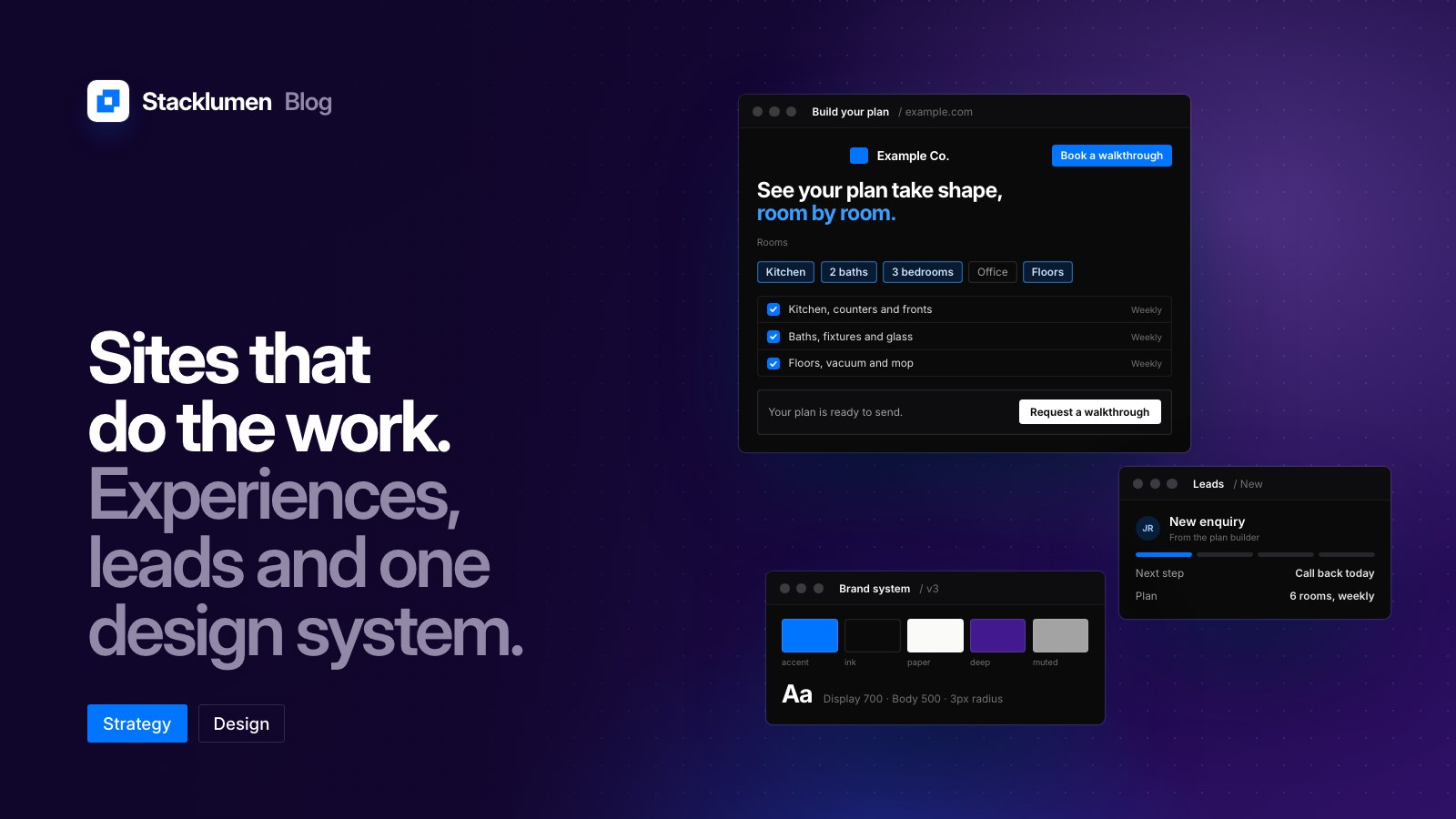
Experiential marketing means the site lets someone do the thing instead of reading a description of it. A cleaning company's visitor builds a plan room by room and watches the checklist take shape. A trading mentor's visitor sizes a position with the same calculator members use. A service business tells its story as you scroll, so the process makes sense before the first call.
This comes from experience-first product design, a term named and defined by Stacklumen founder Iain Feeney: the experience of using something is how its value arrives, not packaging around it. A working tool on the homepage does more than a paragraph about the service. It shows a visitor what working with the business will feel like, and it gives them a reason to stay.
In practice, that means:
- Real tools on public pages. Plan and estimate builders, calculators and checklists, written for the client's own customers, with example figures clearly marked as examples.
- Stories told in order. Pages that walk through how the work happens, one step at a time, as you scroll.
- Members' areas that feel like a product. Progress, lessons, resources and kits behind a sign-in, instead of a PDF sent by email.
2. One clear next step, captured properly
Most small-business sites lose people at the moment they're ready to act. The contact form sends an email, the email gets buried, and nobody can see where an enquiry went.
So every page we build now has one obvious next step: book a walkthrough, request an estimate, start a free consult. That step is captured where the business actually works. Form submissions are kept with the site in Stacklumen Terminal, where every one can be read, searched and followed up, instead of living in one person's inbox. From there, a real enquiry becomes a lead in the client's CRM, with a stage and a next step.
- One primary action per page, repeated in the navigation and never more than a thumb away on a phone.
- Forms that ask for what's needed, so the first reply can already be useful.
- A follow-up path that runs from the first message to a booked call, a quote and an invoice, from the same place.
3. One design system behind everything
As a business grows, its look drifts. The site says one thing, the social banners another, the invoices a third, and the app, if there is one, has its own colours entirely. Each piece is fine on its own. Together they look like several companies.
We now set clients up with one versioned brand system: colours, type, spacing and components as named tokens, and a full brand kit drawn from them. That kit covers logos and lockups, app and web icons, profile pictures, and banners sized for every platform the business uses. The marketing site and the client's app read the same system, so a change made once shows up everywhere.
Owning the result
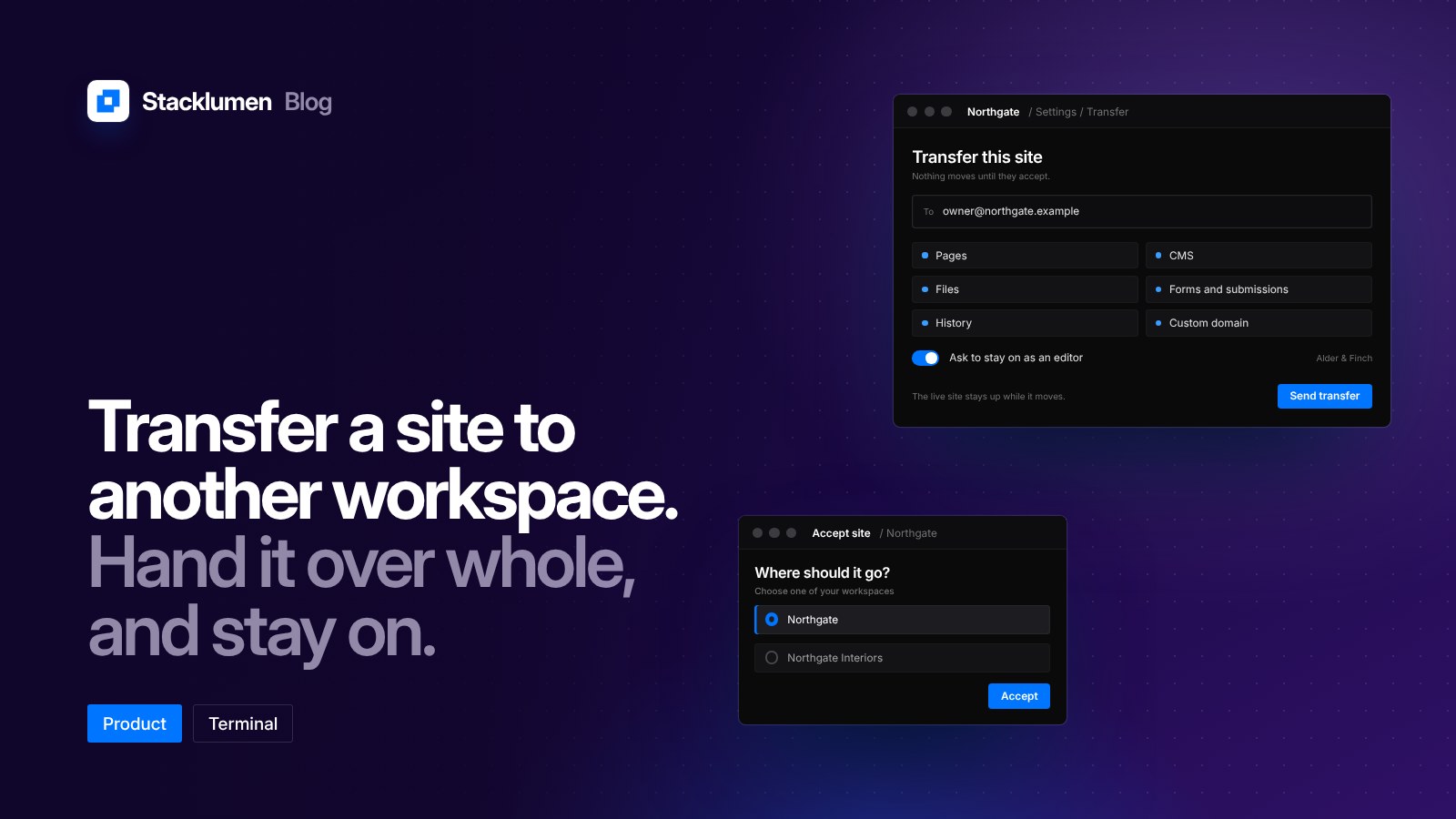
All of this is easier to build, and cheaper to keep up, when the client owns the site. That's why we're moving clients off rented site-builder hosting and onto a codebase that's theirs, hosted by Stacklumen.
Content lives in Stacklumen Terminal's CMS, so posts, services and team pages can be edited and published without touching code. The code itself can be edited visually on a live canvas in StackIDE, our desktop app, and changes go out through the client's own repository. Stacklumen never writes to it. Every change is theirs.
What this means if you're a client
You'll hear from us with a plan for your site: which tool belongs on your homepage, what your next step should be and where it should land, and what your brand system should hold. For some sites that's a rebuild. For others it's a few weeks of focused changes. The goal is the same either way: a site that does part of the work for you.
Questions, or ready to start? Get in touch, or message us from your client portal.