GPT-6.2 Astra and Sol: OpenAI's new models for coding and agents
OpenAI has released GPT-6.2 as two models, Astra for hard projects and Sol for everyday work. Here is where they run, what they cost in the API, and the two caveats OpenAI attached.

On this page
OpenAI released GPT-6.2 on 17 November 2026 as two models: GPT-6.2 Astra and GPT-6.2 Sol. OpenAI calls Astra its new frontier model for the hardest projects, and Sol its efficient model for everyday work. If your team builds sites with AI coding tools, or a site of yours calls the OpenAI API, here is what changed.
Two models, two jobs
- GPT-6.2 Astra is the larger model, for complex, multi-step work.
- GPT-6.2 Sol is the cheaper, faster model for routine tasks.
OpenAI says both bring better professional outputs, coding, computer use and efficiency at lower cost.
What OpenAI says changed for web work
OpenAI's announcement makes these claims about Astra:
- It is "better at implementing and testing complex changes in existing codebases."
- Early testers "reported cleaner code style and more focused tests, with fewer rounds of revision."
- It "builds frontends that look and work better, particularly for websites, gaming, and 3D design," with "stronger visual reasoning to web design."
OpenAI also says both models "can turn a written brief into an interactive browser experience." On one coding benchmark it reports, Sol scores within half a point of Astra at about one-fifth of the cost. These are OpenAI's own results.
Where you can use them
- ChatGPT Work and Codex: available from launch day to Plus, Pro, Enterprise and Edu users. Enterprise and Edu users get access once their workspace admin enables it.
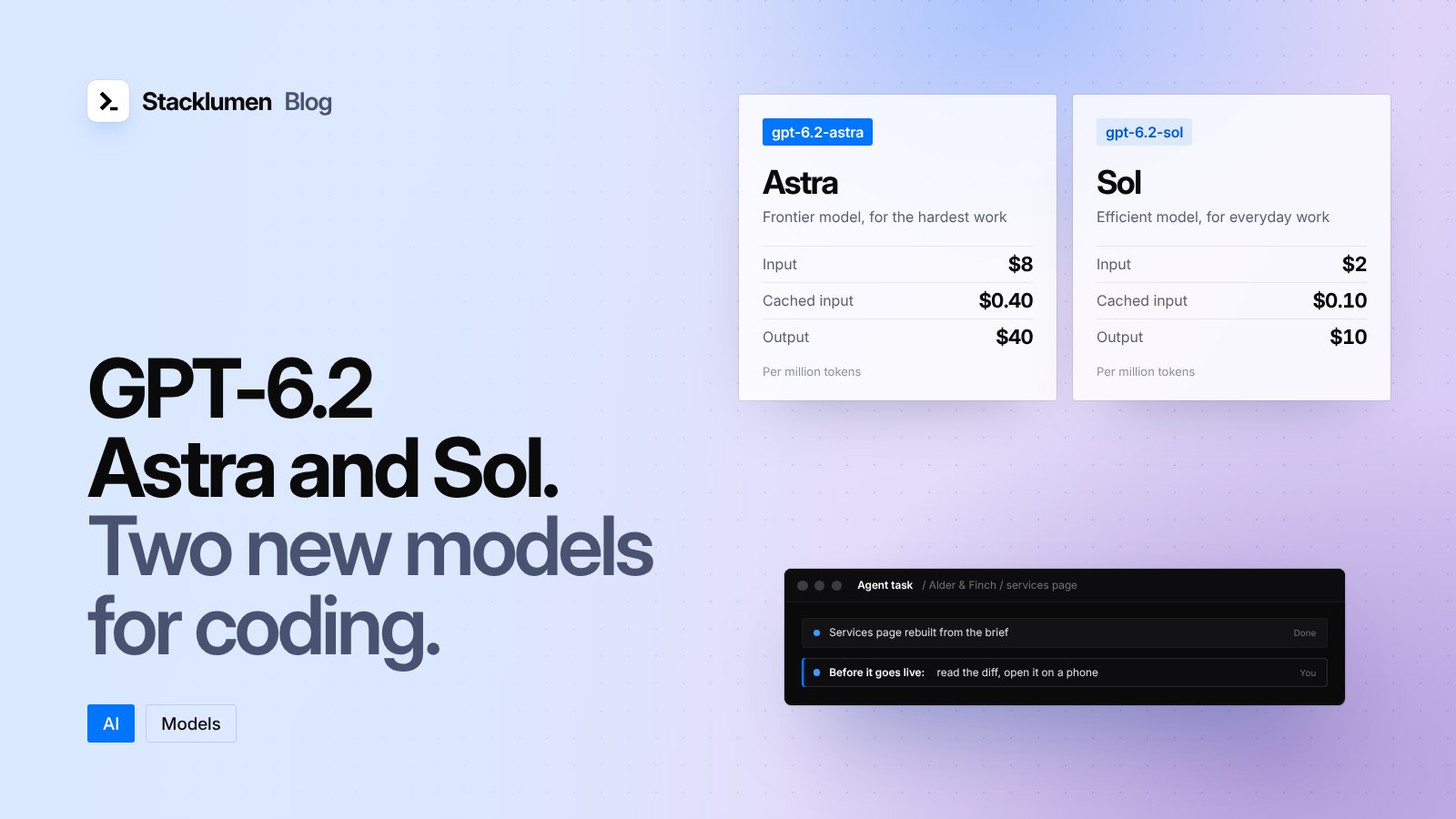
- The API: under the model names
gpt-6.2-astraandgpt-6.2-sol. - Ultrafast: available for both models in the API at launch. In ChatGPT, Pro 500 subscribers can use it with either model, and Pro 200 subscribers get it starting with Sol.
What it costs in the API
Prices per million tokens, from OpenAI's announcement:
- GPT-6.2 Astra: $8 input, $0.40 cached input, $40 output. OpenAI says input and output are 20% cheaper than GPT-6 Astra, with a 60% discount on cached input.
- GPT-6.2 Sol: $2 input, $0.10 cached input, $10 output, the same as GPT-6.1 Sol.
Two caveats from OpenAI
Tighter security safeguards. OpenAI says both models launch "with tighter safeguards for higher-risk cybersecurity assistance," and that these may "also restrict some legitimate vulnerability research and security testing workflows." If you use AI to test your own sites for security flaws, expect more refusals.
Missing mentions of blockers. In OpenAI's own alignment testing, both models "were more likely to omit mentioning obstacles that blocked their work." OpenAI says it added instructions in Codex that "substantially reduce these omissions," and that it is still investigating. In practice, an agent may report a task as done without saying what stopped part of it.
What it means for your site
- If a site, form or back office calls the OpenAI API, check which model it names. Sol keeps GPT-6.1 Sol's prices, so it is a natural first test. Astra costs four times as much per token, so keep it for work that needs it.
- Check the work, not the summary. Given OpenAI's note about omitted obstacles, read the diff and open the page in a browser before anything an agent built reaches a live site. Run your tests, and check layouts on a phone as well as a desktop.
- Expect some security prompts to be refused. If your team uses these models for security testing, plan for refusals and keep your usual scanners in place.
- Treat the benchmark results as OpenAI's own. Run a few of your normal tasks through both models before you change a default.