Gemini 4 Hydrogen is out: Google's fast model for coding and agents
Google has released Gemini 4 Hydrogen, a faster model for everyday coding and agent work. Here is what it costs, where it runs, and what to change when you move an older integration over.

On this page
Google released Gemini 4 Hydrogen on 12 November 2026. It is the fast model in the Gemini 4 family, built for everyday coding and agent work, and it sits next to the larger Gemini 4 Carbon and Gemini 4 Argon. If you build sites with AI coding tools, or call the Gemini API from a site or a back office, this is the model Google now points you to for routine work.
What Google released
Google describes Hydrogen as the faster model for everyday coding and agentic execution, while Carbon and Argon handle deep, long-horizon reasoning. It can work on its own or as the model that carries out tasks while a larger model plans them.
Google lists these uses: coding and debugging inside a repository, interactive web development, and multimodal workflows. Its announcement says the model produces more functional, feature-complete layouts in fewer prompts for UI prototyping and design-to-code work.
Google also reports, against Gemini 3.8 Flash, that Hydrogen finishes tasks 2.5 times faster at its default setting, scores 57% on Terminal-Bench 4.1 against 18.2%, and makes more than five times fewer fabricated claims. These are Google's own figures.
Where you can use it
- Developers: the Gemini API, Google's web-based AI development tool and Android's official IDE.
- Businesses: Gemini for business, through the API or the model menu.
- Google Antigravity: Google's agent coding tool, for paid Google AI Pro and Ultra subscribers. Its Orchestrator feature can switch between Carbon and Hydrogen in one session.
- Everyone else: the Gemini app's model menu and Google Search.
The numbers developers need
From Google's developer guide for the model:
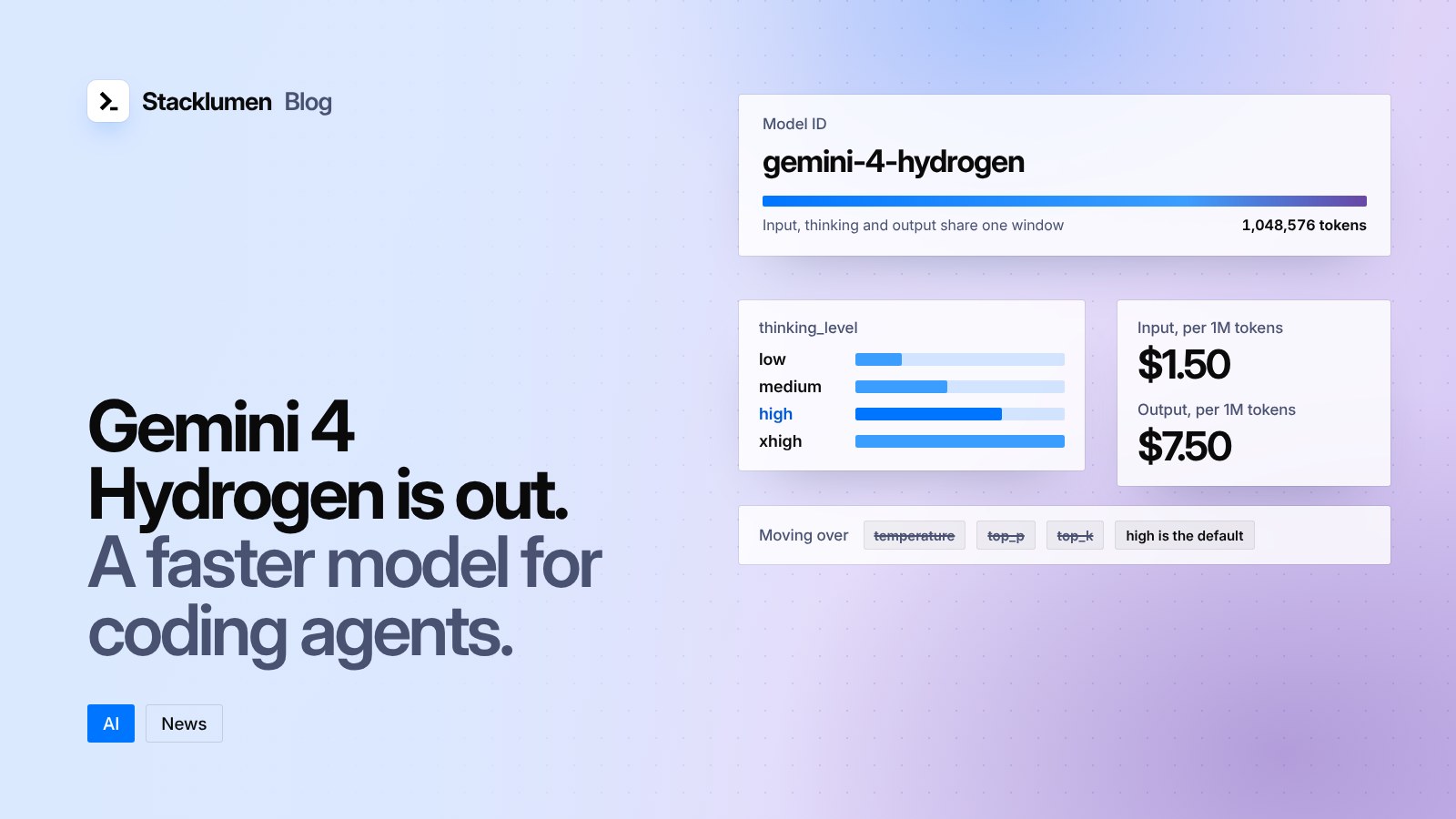
- Model ID:
gemini-4-hydrogen. - Context: input, thinking and output share one window of 1,048,576 tokens. A single synchronous request can return up to 65,536 output tokens.
- Price, standard paid tier: $1.50 per million input tokens and $7.50 per million output tokens, with thinking tokens counted as output. Batch and Flex are half that.
- Thinking levels: set with
thinking_level:low,medium,highandxhigh. The default ishigh. The model refusesminimalwith an error. - Caching: implicit only, on prompts of at least 4,096 tokens. Explicit caching is not supported.
- Tools: function calling, structured outputs, and grounding with Google Search and Google Maps. Grounding includes 5,000 free requests a month, shared with other Gemini models, then $14 per 1,000.
Moving an older integration over
Google recommends Hydrogen as the upgrade from Gemini 3.8 Flash and earlier Gemini 3 and 2.5 models. Its guide lists changes that can break code that worked before:
- Change the model ID to
gemini-4-hydrogen. - Remove
temperature,top_pandtop_k. Values out of range return a 400 error. - Remove
cached_contentfields, because explicit caching is not supported. - Raise or remove low caps on
max_output_tokens, such as 8,192. - Test
mediumas well ashigh: the default moved frommediumtohigh, which can change both speed and cost. - Declare tools natively, or use structured outputs, rather than asking for JSON in plain text.
- Keep thought signatures in histories you manage yourself, and use
previous_interaction_idfor multi-turn sessions.
What it means for your site
- If a site or form calls Gemini today, check which model it names. Moving to Hydrogen is mostly a model ID change, but the removed sampling settings and caching fields will return errors if you leave them in.
- Watch the bill after switching. The default thinking level is now
high, and thinking tokens are billed as output. Trymediumfor short, interactive tasks such as chat on a site. - If your team uses AI coding agents, Google's developer guide lists Hydrogen as the default model for the Antigravity agent. As with any model change, review generated layouts and code before they reach a live site.
- Treat the speed and accuracy claims as Google's own. Run your usual tasks through it before you change anything in production.