MCP specification releases move to a twice-yearly schedule
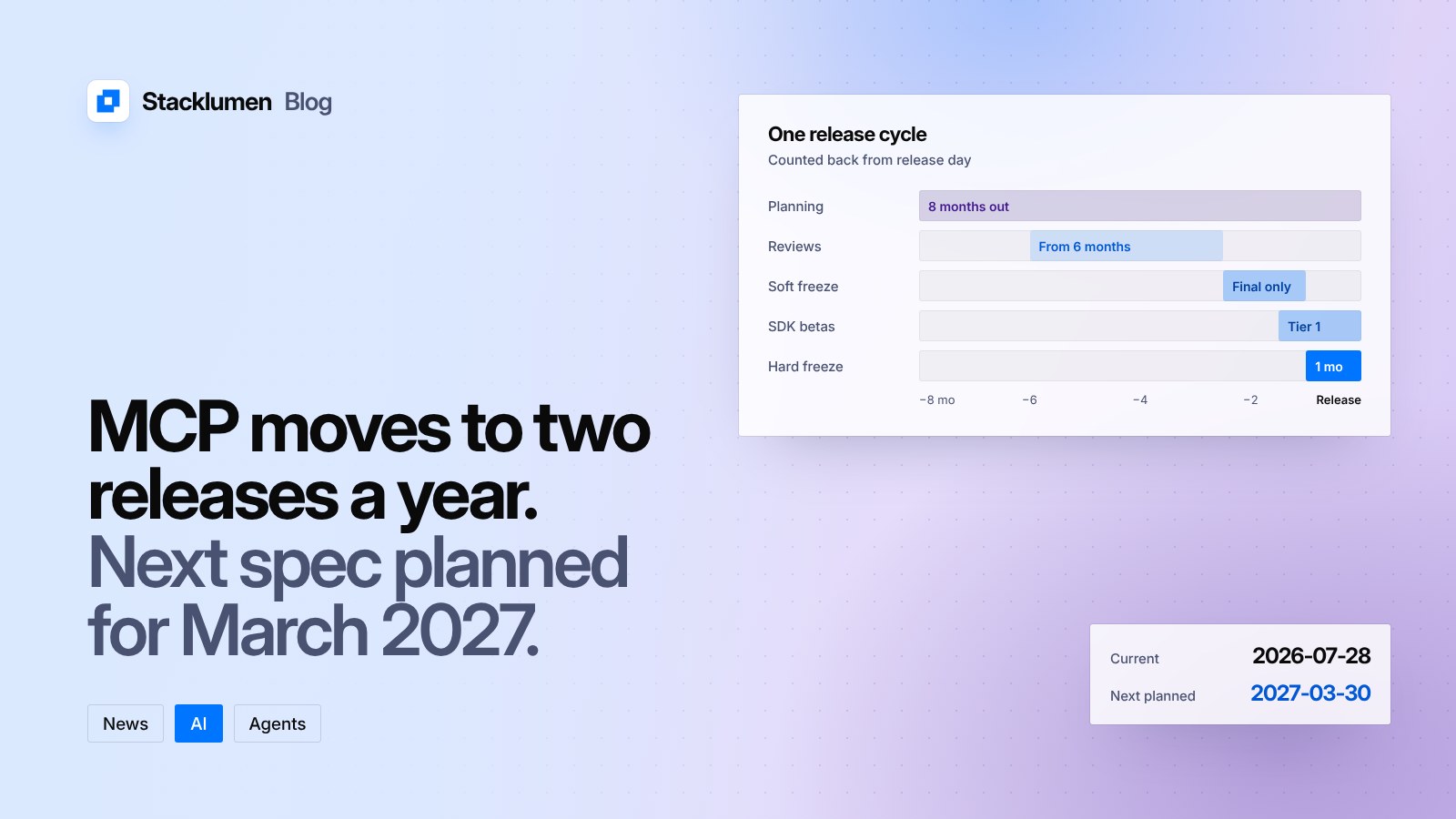
New versions of the Model Context Protocol will now ship on the last Tuesday of March and September, with the next planned for 30 March 2027. Existing clients and servers need no changes.

On this page
The Model Context Protocol (MCP) is the open standard that lets AI agents connect to tools and data, including the MCP server in Terminal. On 11 November 2026, the project's lead maintainers announced that new versions of the MCP specification will now ship on a fixed schedule: twice a year, generally on the last Tuesday of March and September.
The next release is planned for 30 March 2027, as version 2027-03-30.
Where the specification stands today
MCP versions are named by date. The current version is 2026-07-28. It was a large release with breaking changes. According to the release candidate post, it made the protocol stateless: the initialization handshake and session IDs are gone, and client details now travel with each request. It also moved Tasks out of the core protocol into an official extension, and deprecated Roots, Sampling and Logging, which still work in that release.
Under the versioning rules, a version number only changes when a backwards-incompatible change is made. Each request declares the version it uses. A server that does not support it answers with an error that lists the versions it does support.
The new release cycle
The announcement sets out fixed stages, counted back from each release day:
- Eight months before: planning starts. Maintainers and working groups gather feedback on priorities.
- Six months before: Core Maintainer reviews of proposals begin, and run until the soft freeze.
- Two and a half months before (soft freeze): every proposal going into the release must be marked Final and merged. After this point only fixes, polish and clarifications are accepted, not new features.
- One and a half months before: Tier 1 SDKs publish betas that support the frozen specification.
- One month before (hard freeze): only critical security fixes, or fixes that block the release, are allowed, and each needs a vote of the Core Maintainers.
- Release day: the specification and release notes are published, with guidance for implementers.
A proposal that is not ready moves to a later release instead of delaying the whole specification. If an SDK is late, the gap is documented and the release date does not move. The maintainers say the March 2027 release is slightly different from later ones, because some of its planning finished in August 2026.
What does not change
The announcement is clear that this is a change to how releases are prepared, not to the protocol itself. In its words, "there's nothing you need to change in an existing client or server because of this announcement." Version names stay date-based, and the way clients and servers agree on a version is unchanged.
What it means for your site
If you or your developers use AI agents to build or manage websites, most of the MCP servers and clients you rely on will follow this calendar. A few practical points:
- Expect protocol changes in March and September. Release dates are now known months ahead, so you can plan upgrades of any MCP servers you run, or agent tools you depend on, around them.
- Test against the SDK betas. Tier 1 SDK betas arrive about six weeks before each release. If you maintain your own MCP server, that is the window to check it against the new version.
- Read the soft-freeze list. About ten weeks before release, the set of changes is fixed. That is a good time to see whether anything will affect the agents and tools you use.
- No action is needed today. Nothing in this announcement requires a change to an existing client or server.
Terminal includes an MCP server, which lets AI agents work on Stacklumen sites.