Let's Encrypt now checks your domain from six remote places
Since 10 November, Let's Encrypt validates every certificate request from its primary datacenter and six remote network perspectives, ahead of a rule that applies to all certificate authorities from 15 December. Sites that block traffic by region may see renewals fail.

On this page
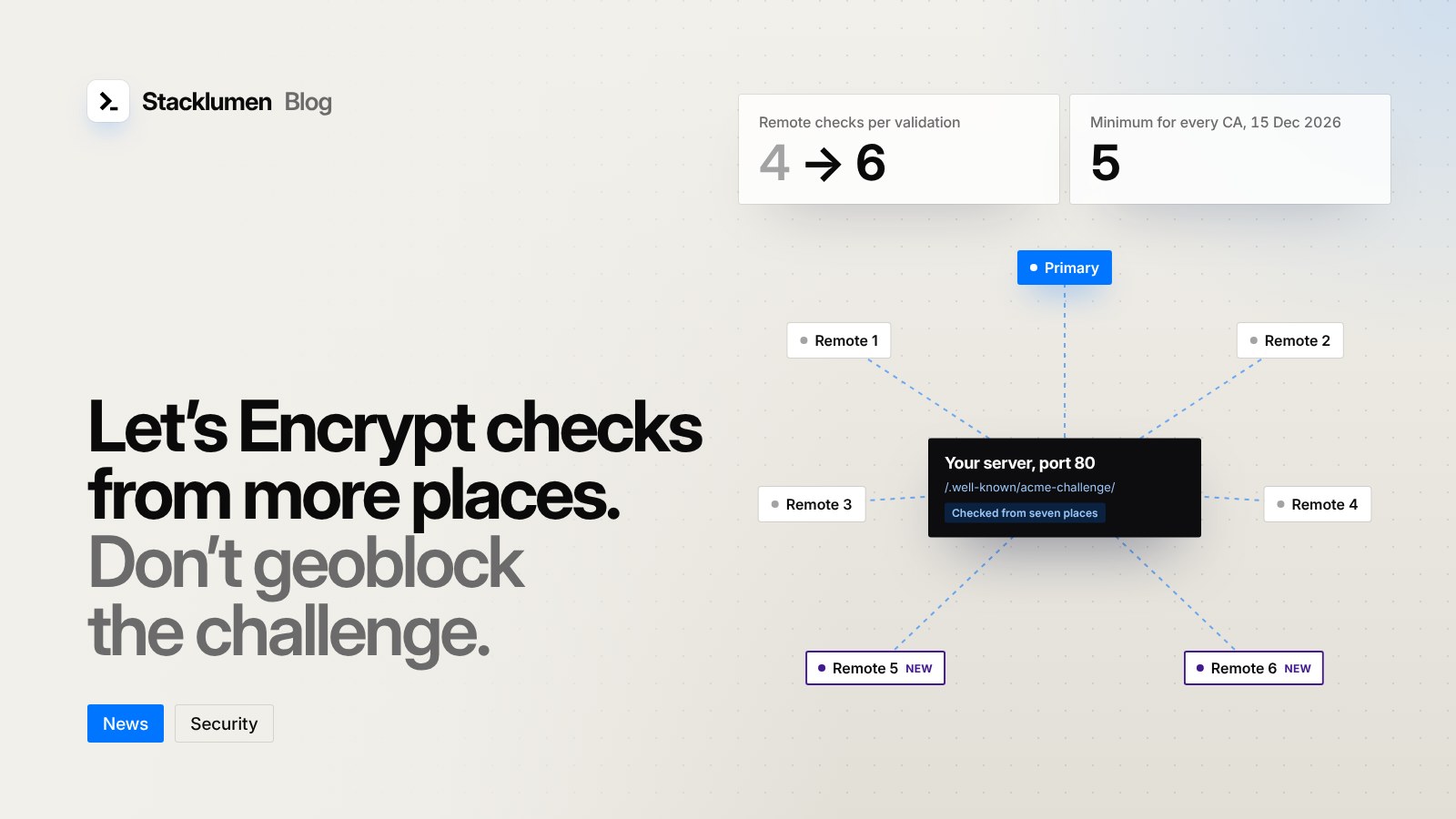
Let's Encrypt now checks that you control a domain from more places before it issues a certificate. Since 10 November 2026, its production service sends seven validation requests for each check: one from its primary datacenter and six from remote network perspectives, up from four. The change follows a rule that applies to every public certificate authority from 15 December 2026.
What changed
When you ask Let's Encrypt for a certificate, it has to confirm that you control the domain. It does this by asking your server or your DNS for a token your ACME client has put in place. With multi-perspective validation, it asks from several networks at once, so an attacker who hijacks traffic in one part of the internet cannot pass the check alone.
Let's Encrypt announced on 15 October that it was adding two more remote perspectives. The new regions went live in its staging environment on 27 October, and in production on 10 November. For validation to succeed, the primary server and a quorum of the remote perspectives must receive the correct challenge response. Let's Encrypt said it expects little to no impact on users.
Why it is happening
The CA/Browser Forum's Baseline Requirements set the rules public certificate authorities follow. Section 3.2.2.9 says that from 15 December 2026, a CA must use at least five remote network perspectives, and those perspectives must sit in the service regions of at least two different Regional Internet Registries. If the requirement is not met, the CA must not issue the certificate.
The same section sets how many remote checks may disagree. With two to five remote perspectives, one may fail to corroborate. With six or more, two may. The rule covers both the domain control check and the CAA record check, which confirms that your DNS allows the CA to issue for your domain.
Let's Encrypt first introduced multi-perspective validation in February 2020, after researchers at Princeton showed that an attack on internet routing (BGP) could trick a CA into issuing a certificate to the wrong party.
Where validation can fail
The checks only work if every perspective can reach your domain. Let's Encrypt's documentation for the HTTP-01 challenge, the most common type, says it fetches the token from /.well-known/acme-challenge/ on port 80, potentially multiple times from multiple vantage points. It cannot use any other port. It follows up to 10 redirects, but only to ports 80 or 443.
That means the following setups can make a renewal fail:
- A firewall, security plugin or CDN rule that blocks traffic from some countries.
- An allowlist of IP addresses that only lets in known visitors.
- Rate limits or bot rules that challenge or block the validation requests.
- A redirect on port 80 that sends the challenge path somewhere other than port 80 or 443.
The FAQ on Let's Encrypt's community forum says the places it validates from keep changing, so firewall rules based on specific countries will not hold up over time. It recommends allowing worldwide access to your authoritative DNS, and, for HTTP-01, worldwide access to port 80 for the challenge path. Other traffic on port 80 can still be redirected or blocked.
If a server cannot be reachable from everywhere, the DNS-01 challenge is the alternative. It proves control with a TXT record at _acme-challenge.<your domain>, so the web server does not need to be public. Let's Encrypt's documentation notes that it only makes sense when your DNS provider has an API your ACME client can use, and recommends narrowly scoped API credentials.
What it means for your site
If your certificates renew on their own and nothing blocks traffic by region, there is nothing to do. If you manage your own servers, or a client's, check these before your next renewal:
- Look for geoblocking, IP allowlists or bot rules that apply to port 80 or to your DNS. Exempt
/.well-known/acme-challenge/from them. - Do not allowlist Let's Encrypt by IP address or country. The locations change.
- Check that any redirect on port 80 stays on port 80 or 443.
- For servers that must stay private, move to DNS-01 with a scoped DNS API key.
- Watch your ACME client's logs after the next renewal. If it fails, check whether a regional block or bot rule stopped some of the requests.
The same rule applies to every public certificate authority from 15 December, so a site that buys certificates elsewhere should expect validation from more places too.
Sources
- Let's Encrypt: adding two additional remote perspectives for domain validation (announcement and rollout updates)
- CA/Browser Forum Baseline Requirements, section 3.2.2.9: Multi-Perspective Issuance Corroboration
- Let's Encrypt: Challenge types
- Let's Encrypt: Multi-Perspective Validation Improves Domain Validation Security (2020)
- Let's Encrypt community forum: Multi-Perspective Validation and Geoblocking FAQ