Node.js 27 alpha is out: the first release under the yearly schedule
Node.js 27 has entered its alpha phase, the first line under the project's one-release-a-year schedule. It brings V8 15.6 and changes worth testing now, but it is not meant for production.

On this page
Node.js 27 is now in alpha. It is the first release line under the new Node.js schedule, which moves the project from two major releases a year to one. The first alpha build came out on 29 October 2026 and a second, 27.0.0-alpha.0.1.0, followed on 12 November. Neither is meant for production. They are there so library authors and teams with test pipelines can find breaking changes early.
One release a year, and every release becomes LTS
The Node.js project announced the change in March. Starting with 27.x, there is one major release a year, in April, and it is promoted to long-term support (LTS) in October. The old split between odd-numbered releases, which never became LTS, and even-numbered ones is gone. Node.js 27 will become LTS.
Each line now goes through four phases:
- Alpha, about six months from October to March, for early testing. Breaking (semver-major) changes are allowed.
- Current, about six months from April to October, for stabilisation.
- LTS, 30 months of long-term support with security fixes.
- End of life, when the project stops supporting it.
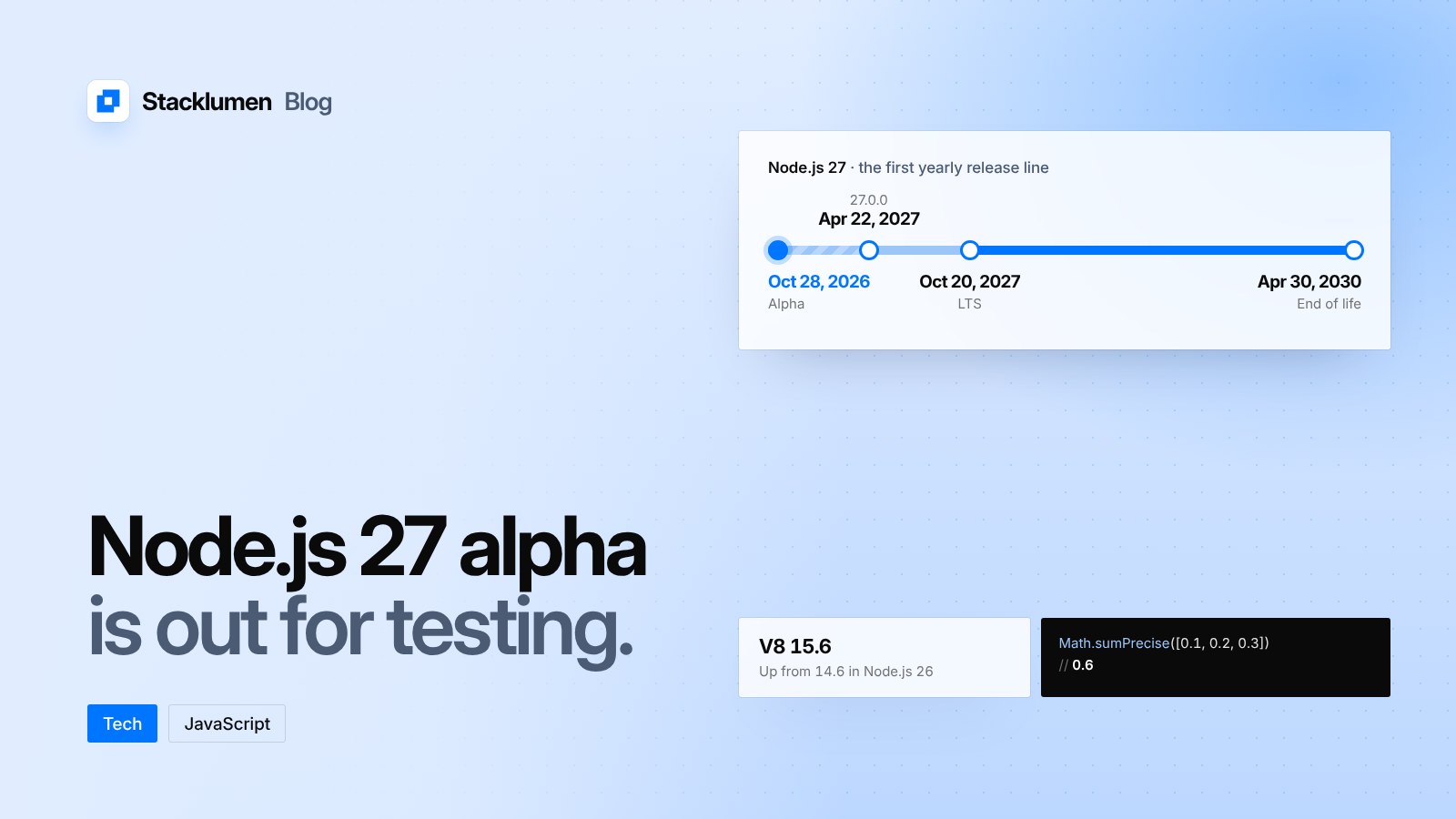
The project's release schedule file gives these dates for Node.js 27: alpha from 28 October 2026, 27.0.0 on 22 April 2027, LTS on 20 October 2027 and end of life on 30 April 2030. Node.js 26 is the last line under the old model. It became LTS on 28 October 2026 and is supported until 30 April 2029.
The project says that if you already upgrade only to LTS versions, "little changes beyond version numbering". It also notes that the schedule "is not final and may be amended".
What the alpha channel is for
Alpha releases replace the early-testing role odd-numbered releases used to play. Unlike nightly builds, they are signed, tagged and tested against the test suites of major open-source packages. The project describes them as "not intended for production use", and their APIs may change between releases. It asks library authors to add alpha releases to their CI as early as possible, so bugs are reported before they reach users.
What is new in the 27 alphas
Node.js 27 moves from V8 14.6 to V8 15.6. The Node.js team published a long post on what that changes. Among the points most likely to matter to people who build websites:
- New JavaScript features on by default, including
Math.sumPrecise(), which adds numbers with less floating-point error (Math.sumPrecise([0.1, 0.2, 0.3])returns0.6), and new iterator methods such asIterator.zip()andIterator.prototype.includes(). - A higher default memory limit. The default old-generation heap limit is now half of physical or container memory, between 256 MB and 4 GB. On an 8 GB machine it rises from 2 GB to 4 GB. If you relied on the old limit, set
--max-old-space-sizeyourself. - A new serialisation format. Data written by
v8.serialize(),structuredClone()andpostMessagein 27 cannot be read by older Node.js releases. Node.js 27 can still read older data. - Small behaviour changes that can break tests. Some
Mathfunctions can return results that differ in the last bit, larger arrays are sorted with a different algorithm, andgetTimezoneOffset()is no longer rounded to whole minutes for historical time zones. - Removed and renamed flags. For example,
--experimental-wasm-<name>flags become--wasm-<name>, and live editing through the inspector is removed. - Larger heap snapshots that now include full script source. The post says they "should be treated as sensitive data".
The 12 November alpha also adds smaller features, including X.509 certificate generation with CSR support in crypto, a subprocess.timedOut property in child_process, and coalescing of identical concurrent dns.lookup() calls.
What it means for your site
- Production sites should stay on LTS. Node.js 26 is the current LTS line. Keep it patched; the most recent security releases came out on 11 November.
- If you maintain packages, plugins or a shared build setup, add a Node.js 27 alpha job to your CI now. Breaking changes are allowed until April, and early reports are what the alpha phase is for.
- Check memory settings. If your hosting relies on Node.js's default heap limit, the new default may change how much memory your build or server uses. Set the limit explicitly where it matters.
- Watch for stored serialised data. If one service writes
v8.serialize()output that an older Node.js version reads, plan for the new format before you upgrade the writer. - Plan upgrades around April and October. From now on, a new major arrives each April and becomes LTS each October.