Chrome 159 beta: per-axis scroll snap, prerendered frames and sign-in without a form
Chrome 159 is in beta, with stable due on 8 December 2026. It changes how nested scroll snapping works, lets pages opt in to prerendering cross-origin frames, and trials a passkey sign-in suggestion that needs no login form.

On this page
Chrome 159 entered beta on 12 November 2026. Chrome's release notes list 17 changes, and the stable release is scheduled for 8 December 2026. Most of the list is about WebTransport, which few websites use directly. A handful of changes touch everyday sites: how scroll snapping works, how pages with embedded content load, how a sign-in prompt can appear and how two CSS colour keywords behave.
Scroll snap works per axis
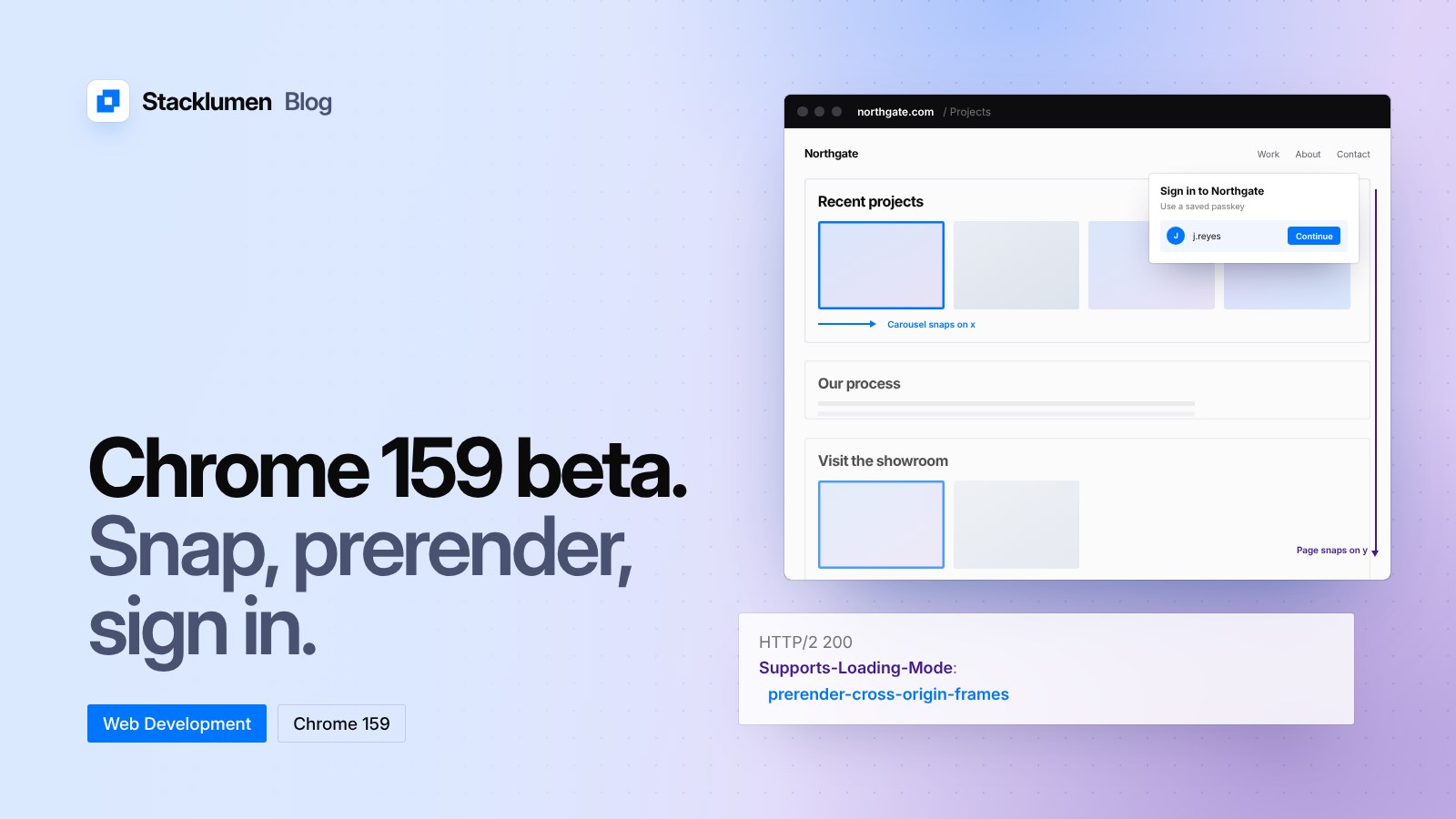
In Chrome 159, a single-axis scroll container handles snapping only for the axis it can scroll. Snapping in the other axis passes to the nearest ancestor that scrolls in that direction.
This matters for layouts that nest scrollers, such as a horizontal carousel inside a page that snaps vertically between sections. The release notes list this feature as pending review, so check its status before relying on it.
Prerendering pages with cross-origin frames
Chrome can prerender a page before a visitor opens it, so it appears almost at once. Chrome 159 adds an opt-in for prerendering the cross-origin frames inside such a page, such as an embedded map, video or booking widget. A site opts in by sending this response header on the top-level page:
Supports-Loading-Mode: prerender-cross-origin-frames
Without the header, nothing changes. This feature is also listed as pending review.
A sign-in suggestion without a login form
A new origin trial adds a passive mode to Conditional UI in the Web Authentication API. It lets a site offer sign-in with a passkey or saved password through navigator.credentials.get() without autofill, so the page does not need a login form. Chrome shows a non-modal sign-in suggestion instead. The notes say it can be used alongside conditional mediation, and that if the visitor has no saved credentials, the request never resolves. As an origin trial, it works only on sites that register for it.
CSS colour and background changes
- The
AccentColorandAccentColorTextsystem colours now follow the element's ownaccent-colorvalue instead of only the operating system's accent colour. This matches CSS Color Level 4. - The computed values of the
background-*properties now keep the number of comma-separated values you wrote, instead of repeating or trimming them to match the number of background images. CSSImportRule.styleSheetreturnsnullwhen an@importrule has no style sheet, for example when itssupports()condition is false.
Other changes
- The Sanitizer API gets a
javascriptURLsoption, so you can choose whetherjavascript:URLs used for navigation are removed. Behaviour without the option is unchanged. setMicrophoneActive()andsetCameraActive()in the Media Session API now return a promise, as the W3C specification says.- Speech recognition results gain proposed
speechStartTimeandspeechEndTimeattributes, to link transcribed text to a point in the media. - Seven WebTransport changes add stream prioritisation, congestion control options, statistics and error handling.
What it means for your site
- If your pages nest scroll containers with scroll snapping, test them in Chrome Beta before 8 December. A carousel inside a snapping page is one example of a layout this affects.
- If you use
AccentColororAccentColorTextand also setaccent-color, check that form controls and highlights still look right. - If your site embeds third-party frames and visitors often arrive from prerendered links, the new header is worth testing once the feature leaves review.
- Passkey sign-in without a form is an origin trial. Try it on a test site, not in production flows that depend on it.
Sources
- Chrome 159 beta, Chrome for Developers
- Chrome 159 release notes, Chrome Platform Status
- Scroll snap for single-axis scroll containers, Chrome Platform Status
- Prerendering cross-origin iframes, Chrome Platform Status
- Web Authentication Conditional UI Passive Mode, Chrome Platform Status
- AccentColor and AccentColorText follow accent-color, Chrome Platform Status
- Sanitizer javascriptURLs option, Chrome Platform Status
- Background layer count independence, Chrome Platform Status