OpenSSL lists eight low severity flaws, with fixes due 1 December
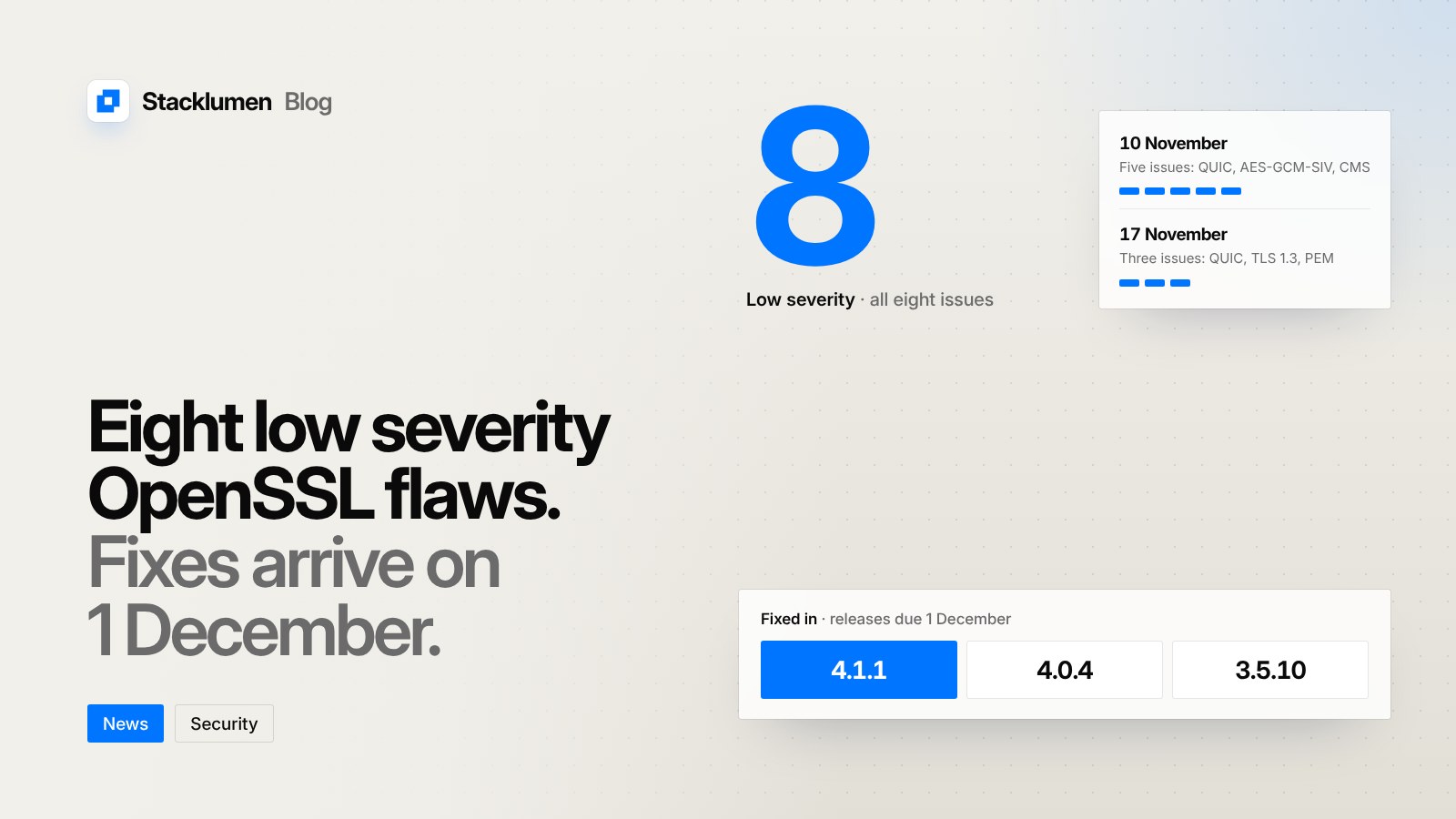
Two OpenSSL advisories this month list eight issues, all rated Low. The fixed releases, 4.1.1, 4.0.4 and 3.5.10, are scheduled for 1 December 2026.

On this page
OpenSSL, the open source library many web servers use for HTTPS, has published two security advisories this month. The first, on 10 November, lists five issues. The second, on 17 November, lists three more. All eight are rated Low severity, and the releases that fix them are scheduled for 1 December 2026.
Nothing here calls for an emergency patch. But if you run your own servers, or you build software that links OpenSSL directly, it is worth knowing which versions are affected and putting 1 December in the calendar.
What Low severity means
OpenSSL's security policy describes Low severity issues as ones that only affect the openssl command line tool, cause only a denial of service for less common protocols or on the client side only, or need several unlikely conditions to be true before an attack can work.
Low severity fixes do not get a release of their own. The fixes go into the public code straight away, and they ship in the next scheduled patch release. The policy adds that if an issue is later found to be more serious, OpenSSL will publish a new release as soon as possible.
The versions affected
The fixed releases are OpenSSL 4.1.1, 4.0.4 and 3.5.10. Most of the eight issues affect only OpenSSL 4.1, 4.0 and 3.5. Two of them also reach the older 3.0, 1.1.1 and 1.0.2 branches; for those, fixes in 3.0.24, 1.1.1zk and 1.0.2zt go to OpenSSL's premium support customers.
In both advisories, OpenSSL says the FIPS modules are not affected by any of the issues.
The 10 November advisory
- CVE-2026-88822. In QUIC's automatic peer detection, an application can be given an invalid address. That can break the connection and can expose uninitialised stack data to anyone watching the traffic.
- CVE-2026-95691. A malicious QUIC server can trigger a use-after-free read in the OpenSSL QUIC client, causing a denial of service or revealing about one byte of heap memory.
- CVE-2026-88823. In the AES-GCM-SIV cipher, a zero-length update of the authenticated data wipes out what was supplied before, so that data can go unprotected.
- CVE-2026-95692. Also in AES-GCM-SIV: an IV shorter than expected can cause an out-of-bounds read, and a longer one is silently cut short instead of being rejected.
- CVE-2026-107496. Encrypting a CMS message to a certificate whose elliptic curve group has an order of 1 can loop forever, if an attacker can supply that certificate. In OpenSSL 4.0 and later, only builds made with the
enable-ec_explicit_curvesoption are affected.
The 17 November advisory
- CVE-2026-124709. A QUIC client that keeps a connection open and repeatedly opens and resets streams can make the server's memory grow without limit. OpenSSL says the default configuration is affected.
- CVE-2026-35190. A crafted TLS 1.3 handshake can make a server read past the end of an array, but only when the application has turned on the Suite B certificate flag. No memory is sent back, though hardened builds may crash.
- CVE-2026-107493. A use-after-free in a function that reads certificates from PEM files, reachable only when an application passes in its own list and reuses it after a failed read. OpenSSL's own code does not do this.
What it means for your site
- On managed hosting, you do not need to act. Your host maintains the server's TLS library and applies updates like these.
- On your own server, check which OpenSSL you have. Running
openssl versionshows the installed OpenSSL version; a web server built against its own copy may differ, so check that too. If it is 3.5, 4.0 or 4.1, plan to install your distribution's update once it includes 3.5.10, 4.0.4 or 4.1.1. - If your software uses OpenSSL's own QUIC support, give this more attention. Three of the eight issues are in OpenSSL's QUIC code, including the one OpenSSL says affects the default configuration.
- Most people can wait for the release. The fixes are already public on GitHub, but OpenSSL's policy is to ship Low severity fixes in the next scheduled release, which here is 1 December.
- Watch for changes. OpenSSL says its online advisories may be updated with more detail, and a Low issue can be re-rated.