Java4Shell: OpenJDK fixes a Base64 flaw that can lead to remote code execution
OpenJDK and Oracle released fixes on 17 November for CVE-2026-114938, a flaw in the JVM's hardware-accelerated Base64 decoder on some x86-64 processors. Sites and APIs running JDK 17 or newer should update the runtime now.

On this page
On 17 November 2026, OpenJDK published a security advisory and Oracle released patched Java builds for a flaw in the JVM's Base64 decoder. The flaw is tracked as CVE-2026-114938. The security firm that reported it, Calif, calls it Java4Shell. If a website, API or back office you run is built on Java, it is worth checking today.
What the flaw is
The bug is in HotSpot, the part of the JVM that compiles Java code to machine code while it runs. On some x86-64 processors, HotSpot uses a hardware-accelerated routine to decode Base64. Calif says that malformed Base64 input, with padding in the wrong place, can make this routine write past the end of its output buffer. Cloudflare's write-up says an unauthenticated remote attacker can use this to leak memory or to run code on the server.
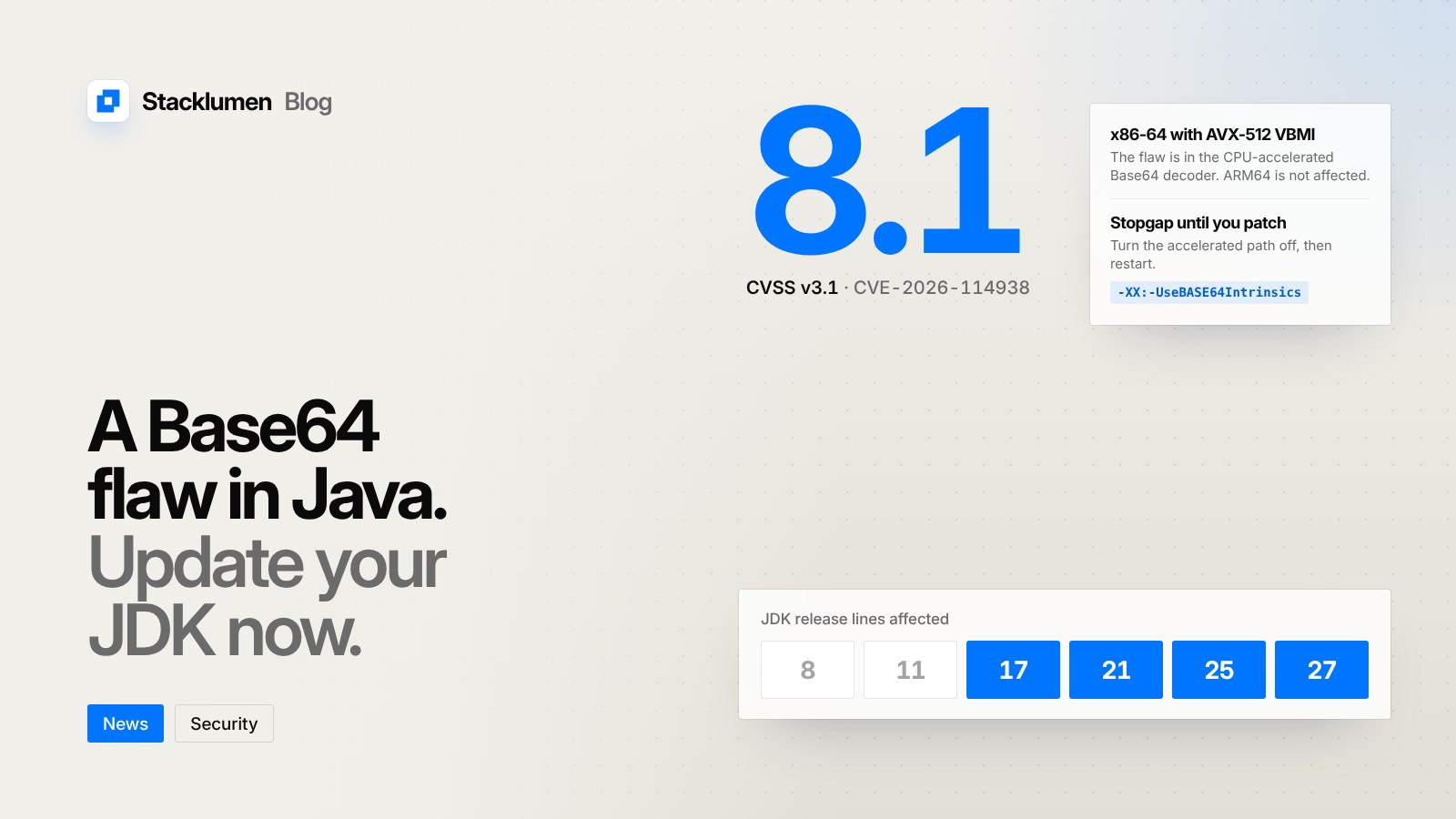
OpenJDK rates it 8.1 out of 10 on CVSS v3.1. Cloudflare's write-up gives a CVSS v4.0 score of 9.2, which is rated critical.
Who is affected
The flaw needs three things to line up:
- A recent JDK. The OpenJDK advisory marks the 17, 21, 25 and 27 release lines as affected. The 8 and 11 lines are not marked for this CVE. Calif says the problem starts at OpenJDK 17.0.6.
- A particular processor. Calif says the vulnerable code only runs on x86-64 processors with AVX-512 VBMI. It names Intel Xeon Ice Lake, Sapphire Rapids, Emerald Rapids and Granite Rapids, and AMD EPYC and Ryzen chips from Zen 4 onwards. ARM64 processors are not affected.
- Untrusted Base64 input. The application has to decode Base64 that an attacker controls with Java's standard decoder. Calif notes that the accelerated routine only kicks in once the JIT compiler has optimised the code after repeated calls. It lists features such as sign-in and file uploads as places where this can happen, and says whether an attack works varies from one application to the next.
Calif says the distributions built from OpenJDK are affected too, and lists Amazon Corretto, Eclipse Temurin, Microsoft Build of OpenJDK, Azul Zulu, BellSoft Liberica, SAP SapMachine, Red Hat OpenJDK, Oracle OpenJDK, Oracle Java SE and Oracle GraalVM for JDK.
Oracle's November 2026 Critical Security Patch Update lists these Oracle Java SE versions as affected: 8u511b33-perf, 17.0.21.0.3, 21.0.13.0.3, 25.0.5.0.3 and 27.0.1.0.3. It also lists Oracle GraalVM for JDK 17.0.21.0.3 and 21.0.13.0.3, and GraalVM Enterprise Edition 21.3.20.0.3.
The rest of the release
The same OpenJDK advisory fixes nine other CVEs in OpenJDK and one in OpenJFX, with CVSS v3.1 scores from 3.7 to 7.5. Two of them, in the JGSS and TLS (javax.net.ssl) code, are rated 7.4 and affect every release line from 8 to 27. Oracle's update carries 11 Java SE fixes in all and says all of them may be exploitable over a network without credentials. So even a server on JDK 8 or 11 should take this update.
Stopgaps if you cannot patch today
Calif lists two JVM flags that switch off the vulnerable code path. Both need a restart, and both may slow the server down.
-XX:-UseBASE64Intrinsicsturns off hardware-accelerated Base64 encoding and decoding.-XX:UseAVX=2turns off AVX-512. Use it only on x86-64 hosts: Calif says the JVM does not recognise it on ARM and will fail to start.
Cloudflare has added six rules for this flaw to its Managed Ruleset on the Pro, Business and Enterprise plans. They are on by default in Log mode, not Block, so they record matches without stopping traffic until you switch them to Block. Cloudflare says the rules are "an additional layer of defense, not a replacement for the patch" and that it has seen no sign of the flaw being exploited on its own infrastructure.
What it means for your site
- Find your Java. List every server, container and managed service that runs a JVM for your sites and clients' sites: application servers, search engines, admin tools and build agents. Note the Java version and vendor for each.
- Check the processor. On a Linux host, Calif suggests running
grep -m1 '^flags' /proc/cpuinfo | tr ' ' '\n' | grep -E '^(avx512f|avx512bw|avx512vbmi|bmi2)$'. If all four flags print, the hardware condition is met. - Update the runtime. Install your JDK vendor's builds that include the 17 November fixes, rebuild container images that bundle Java, and restart. Updating the image without restarting the service leaves the old JVM running.
- Use a stopgap only as a bridge. If a patch has to wait for a maintenance window, apply one of the flags above and plan the update.
- Ask your providers. If a host or vendor runs Java for you, ask them when their runtime will be patched.