nginx fixes ten security flaws: update to 1.31.9 or 1.30.7
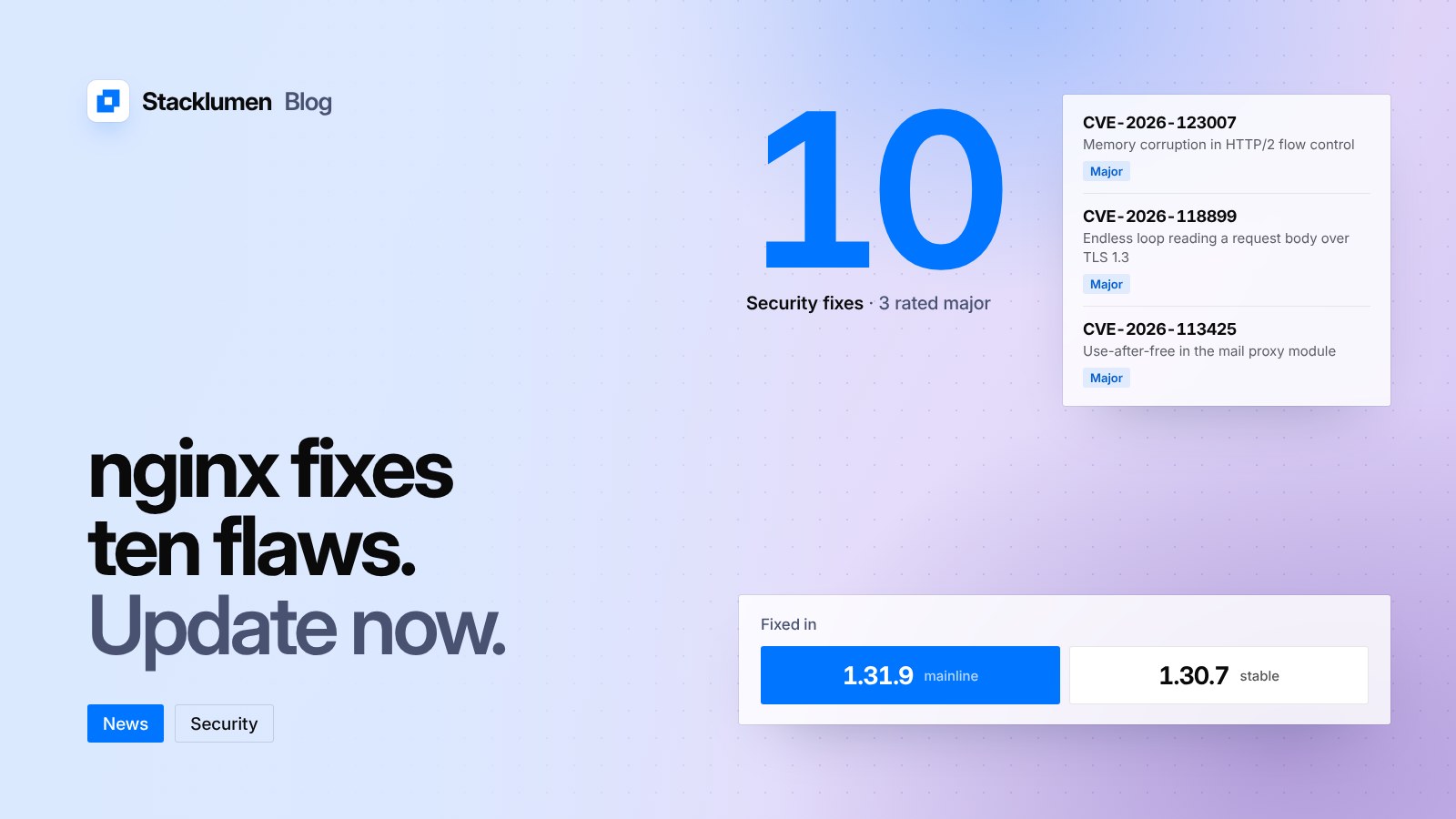
nginx 1.31.9 and 1.30.7, released on 18 November 2026, fix ten security flaws, three of them rated major, including memory corruption in HTTP/2 flow control.

On this page
nginx released two new versions on 18 November 2026: 1.31.9 on the mainline branch and 1.30.7 on the stable branch. Together they fix ten security flaws. nginx rates three of them major, four medium and three minor. If your site, or something in front of it, runs nginx, plan to update.
The three major flaws
- Memory corruption in HTTP/2 flow control (CVE-2026-123007). nginx's change log says a flow control window overflow in HTTP/2 "might allow an attacker to cause a segmentation fault in a worker process, or might have potential other impact". It affects versions 1.9.5 to 1.31.8.
- Endless loop while reading a request body over TLS 1.3 (CVE-2026-118899). Worker processes might get stuck in a loop while reading the request body over SSL. It affects versions 1.13.0 to 1.31.8.
- Use-after-free in the mail proxy module (CVE-2026-113425). This affects the mail proxy server, versions 0.5.33 to 1.31.8.
The other seven
nginx rates these medium or minor. Several depend on how a server is set up.
- Use-after-free in the resolver (CVE-2026-123634), medium. Applies when the
resolverdirective is used and the same name is resolved in several subrequests at once. - Use-after-free in HTTP/2 (CVE-2026-123633) and in HTTP/3 (CVE-2026-121810), medium. Both can happen when
worker_connectionsis not set high enough. - SNI bypass in the stream module (CVE-2026-120967), medium. Client certificates might be checked against the default server's settings instead of the server picked by SNI.
- Buffer overflow with
aliasandtry_files(CVE-2026-125283), minor. Applies in certain configurations that use both directives. - NULL pointer dereference with PROXY protocol version 2 (CVE-2026-120993), minor. Applies with dynamic SSL certificate loading, in versions 1.31.4 to 1.31.8 only.
- Insufficient validation in
ngx_stream_ssl_preread_module(CVE-2026-123640), minor. Malformed ClientHello messages might be read differently than other TLS implementations read them, which might allow security restrictions to be bypassed.
Which versions are fixed
nginx lists 1.31.9 and 1.30.7 as not vulnerable to every flaw above, apart from the PROXY protocol issue, which only ever affected the 1.31 mainline branch and is fixed in 1.31.9. Everything from the oldest affected version up to 1.31.8 is vulnerable to at least one of them.
Other changes in this release
The same release changes two behaviours. Header lines without a colon are now rejected. A request is now also rejected if its chunked request body carries too much framing overhead. If a client or service sends requests that relied on either, it will start getting errors after the update.
The release also fixes several bugs, including a buffer overflow with GeoIP databases in MMDB format that hold invalid coordinates, and incorrect decoding of some QPACK static table values over HTTP/3.
What it means for your site
- Find out whether you run nginx. It is often present without anyone choosing it: as a reverse proxy in front of an app, inside a container image, on a load balancer or in a hosting control panel. Run
nginx -von each server to see the version. - Update to 1.31.9 or 1.30.7. If you install nginx from your operating system's packages, check your distribution's security notices for its fixed package, since distributions publish their own builds on their own schedule.
- Check your container images. Rebuild any image based on an nginx image once a fixed version is available, then redeploy.
- Look at HTTP/2. The most serious flaw is in HTTP/2, which most sites have turned on. If you cannot update straight away, read the advisory and your configuration to judge your exposure.
- Test after the update. Because headers without a colon and some chunked bodies are now rejected, watch your error logs for new 400 responses from older clients or internal services.
- If your host manages the server, ask them. On managed hosting, the provider applies these updates. Ask when they will roll out.