PostgreSQL fixes 52 security flaws, and version 14 reaches end of life
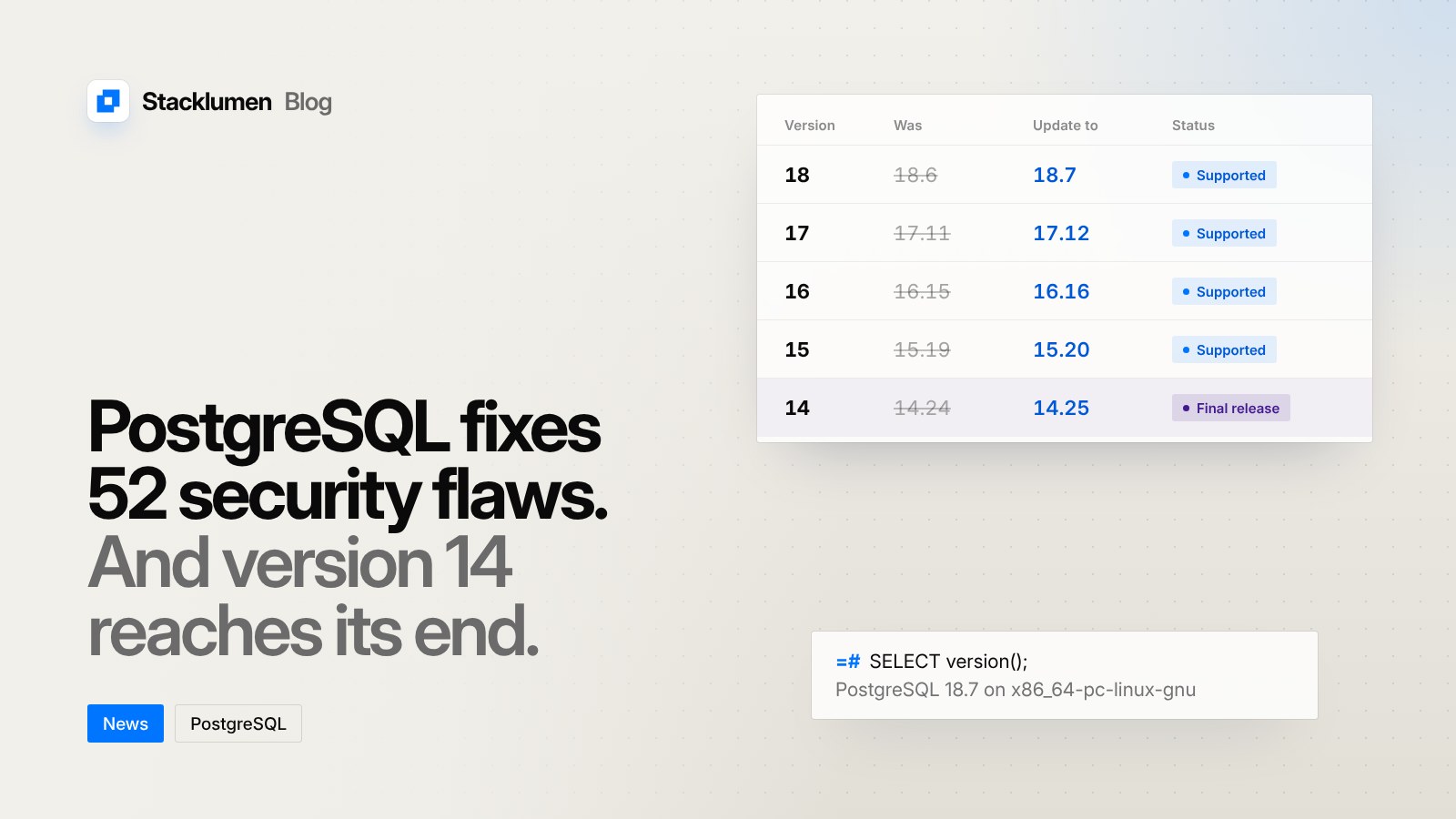
PostgreSQL 18.7, 17.12, 16.16, 15.20 and 14.25 fix 52 security vulnerabilities and over 140 bugs, some needing a reindex after updating. It is the final release of PostgreSQL 14.

On this page
The PostgreSQL Global Development Group released an update to every supported version of PostgreSQL on 12 November 2026. The new versions are 18.7, 17.12, 16.16, 15.20 and 14.25. The project says the release fixes 52 security vulnerabilities and over 140 bugs.
It is also the last release of PostgreSQL 14. From now on, version 14 gets no more security or bug fixes.
If a website, shop or app you run stores its data in PostgreSQL, this update is worth scheduling now.
What the security fixes cover
The release announcement lists 52 CVEs. The highest score among them is 8.8 on the CVSS 3.1 scale, and most of the listed issues are rated 8.0 or higher. Many are described as letting a user "execute arbitrary code".
One example is CVE-2026-6460. The project's advisory says type confusion "allows an object creator to execute arbitrary code as the operating system user running the database", mainly through ALTER ... SET DATA TYPE. Its CVSS vector shows it can be reached over the network but needs a logged-in database user with low privileges. Every version before 18.7, 17.12, 16.16, 15.20 and 14.25 is affected.
Other fixes cover:
- Several flaws in the
plperlandpltclprocedural languages. pg_dump,pg_restoreandreindexdbissues that could allow SQL injection or code execution when restoring or maintaining a database.- Flaws in
dblinkand in logical replication.
The pattern matters. These issues mostly need a database login to exploit. They are serious where a database account is shared, where more than one application or customer uses the same server, or where an attacker already has a foothold in an application.
Bug fixes that need extra steps
Some of the 140 bug fixes repair problems that may already have affected stored data. Updating stops new damage but does not repair it. The project lists these steps after updating:
- GIN indexes. If you suspect a GIN index is affected by the corruption issues fixed here, reindex it with
REINDEX INDEX your_index_name;. - pg_trgm. If you use
pg_trgm, reindex any GiST indexes that use thegist_trgm_opsoperator class. This extension is often used for fuzzy search on websites. - "missing chunk number" errors. If you see these when reading a table, reindex the table with
REINDEX TABLE your_table_name;. - Incremental backups. If you use them, take a new full backup after updating and base later incremental backups on it.
- bpchar columns. Reindex B-tree indexes on columns declared as
bpcharwithout a length. Columns declared aschar(n)are not affected. - Partitioned tables. The announcement includes a query to find
NOT NULL NO INHERITconstraints on partitioned tables, and explains how to drop or repair them.
Applying the update itself is simple. As with other minor releases, you do not need to dump and reload the database or run pg_upgrade. You stop PostgreSQL, update its binaries and start it again.
PostgreSQL 14 is now end of life
The project supports each major version for five years after its first release. PostgreSQL 14 first shipped on 30 September 2021, and 14.25 is its final release.
The support dates for the remaining versions are:
- PostgreSQL 15: until 11 November 2027
- PostgreSQL 16: until 9 November 2028
- PostgreSQL 17: until 8 November 2029
- PostgreSQL 18: until 14 November 2030
Moving from 14 to a newer major version is a bigger job than a minor update. It needs a major version upgrade method such as pg_upgrade or pg_dump and pg_restore.
PostgreSQL 19 is close
The same release includes the second release candidate of PostgreSQL 19. The project plans general availability on 19 November 2026, unless an issue requires a delay or another release candidate. If you are planning a move off version 14, it is worth deciding whether to target 18 now or 19 once it ships.
What it means for your site
- Find out what version you run. Run
SELECT version();against the database, or check your hosting or database provider's dashboard. - Managed database? Check your provider's maintenance notices to see when 18.7, 17.12, 16.16, 15.20 or 14.25 will be applied, and whether you need to approve it.
- Self-hosted? Install your distribution's updated packages or the official binaries, then restart PostgreSQL in a quiet period.
- Do the post-update steps. Work through the list above, especially if you use
pg_trgmsearch, GIN indexes or incremental backups. - Still on 14, or older? Plan an upgrade to a supported major version. Apply 14.25 first, since it fixes the same security issues.
- Review database accounts. Many of these flaws need a database login, so check that each application has its own account with only the rights it needs.