Google's Search Analytics API adds branded, image search and multi-country filters
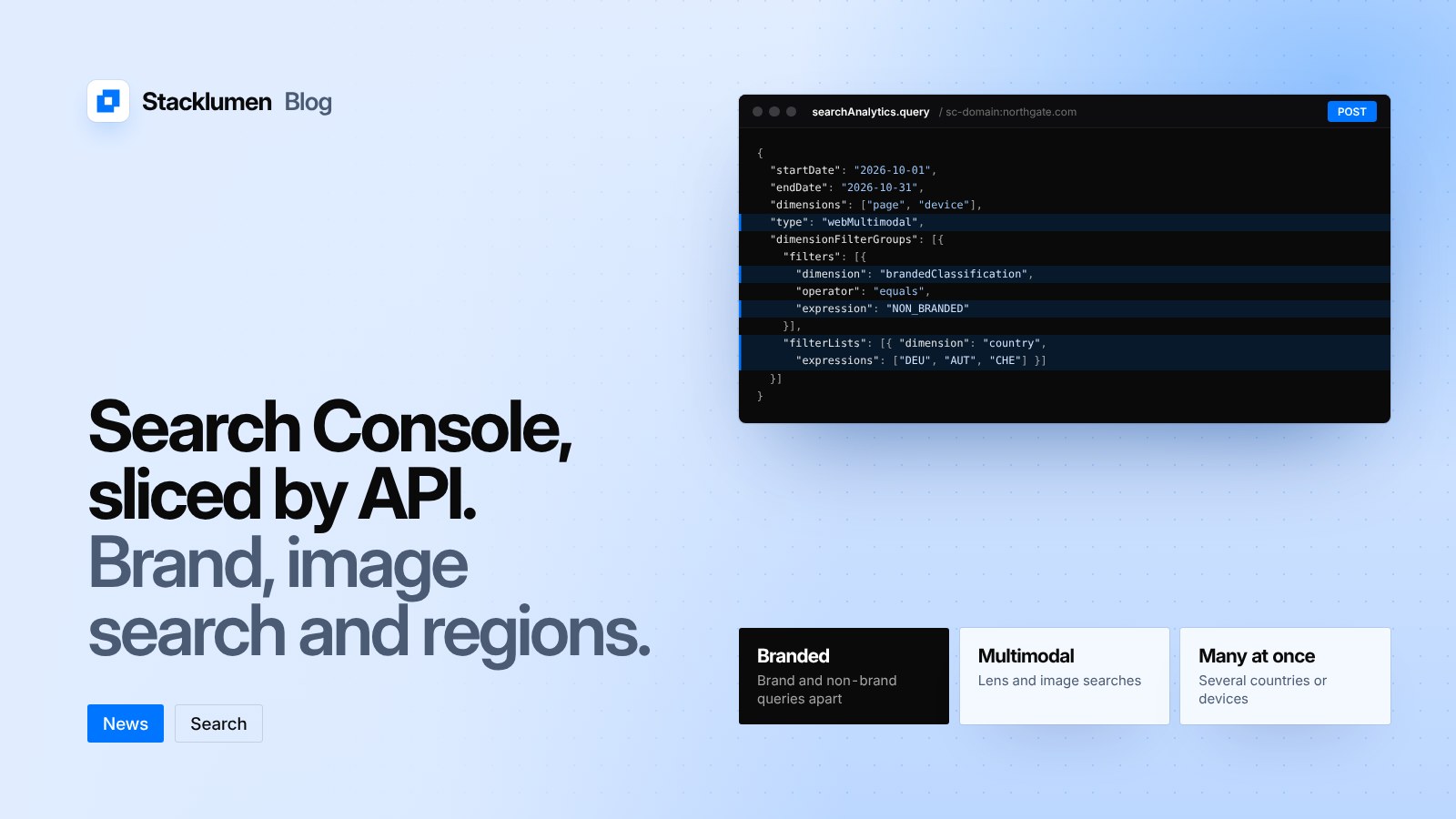
The Search Console API can now split branded from non-branded queries, report searches made with Google Lens and image uploads, and filter by several countries or devices in one request.

On this page
On 16 November 2026, Google added three options to the Search Analytics API, the part of the Search Console API that returns clicks, impressions, click-through rate and position. Each one already existed in the Search Console Performance report. Now the same data can be pulled into your own dashboards, scripts and client reports.
The three additions are a branded queries filter, a search type for image-led searches, and a way to filter by several countries or devices in one request.
Branded and non-branded queries
The API now accepts brandedClassification as a dimension. You can group results by it, or filter to one side with the values BRANDED or NON_BRANDED. Only the equals operator is supported.
This is the same classification as the branded queries filter Google added to Search Console in November 2025. A branded query is one that includes the site's brand name, a misspelling of it, or a product or service unique to the site. Google says the split is made by an internal, AI-assisted system, not by a keyword list, so some queries may occasionally be misidentified. It has no effect on ranking.
There are limits, set out in the API reference:
- Data starts on 21 February 2026.
- It is available only for top-level properties with enough queries and impressions. URL path properties and subdomain properties are not included.
- For a property that does not qualify, the response has no rows.
- A request that filters or groups by
brandedClassificationcannot also use aqueryfilter.
Searches made with images
Setting type to webMultimodal returns performance data for searches made with Google Lens, Circle to Search on Android, and image uploads in Google Search. Search Console started showing this data in its reports in September 2026. Google says it will also reach BigQuery for properties that have an active bulk data export.
Several countries or devices in one request
A new filterLists field inside a filter group lets you match one dimension against several exact values. A row matches if its value equals any of the values listed. It works for two dimensions:
country, using three-letter ISO 3166-1 alpha-3 codes such asDEU,AUTandCHEdevice, usingDESKTOP,MOBILEandTABLET
One request cannot filter the same dimension in both filters and filterLists. Google's post gives the example of querying a region such as DACH, EMEA or LATAM in one call, instead of making one call per country and adding them up.
The three options can be combined. For example, one request can return non-branded multimodal traffic for three countries, grouped by page.
What it means for your site
If you only use the Search Console website, nothing changes. These filters were already in the Performance report.
If you build reports for clients, or feed search data into a spreadsheet or dashboard, there are a few practical points:
- Separate brand from discovery. Non-branded clicks show how people who did not already know the business found it. That is often the more useful number to report after content or SEO work.
- Check eligibility first. Smaller sites may not have enough volume for the branded split, and the API will return nothing rather than an error. Treat an empty result as "not available", not as zero traffic.
- Look at image-led searches. If a site sells products, shows places or relies on photography,
webMultimodalshows whether its pages are reached through Lens and similar tools. - Simplify regional reports. Agencies with clients in several markets can request a group of countries in one call, which also removes the need to merge results later.
- Mind the start date. Branded data begins on 21 February 2026, so year-on-year comparisons are not yet possible.
The full list of supported values and combinations is in the Search Analytics API reference.
Sources
- New filtering and reporting capabilities in the Search Analytics API (Google Search Central Blog, 16 November 2026)
- Search Analytics: query (Search Console API reference)
- Introducing the branded queries filter in Search Console (Google Search Central Blog)
- Announcing web multimodal Search performance reporting in Search Console (Google Search Central Blog)