Ruby fixes seven security flaws: update to 4.0.10, 3.4.13 or 3.3.14
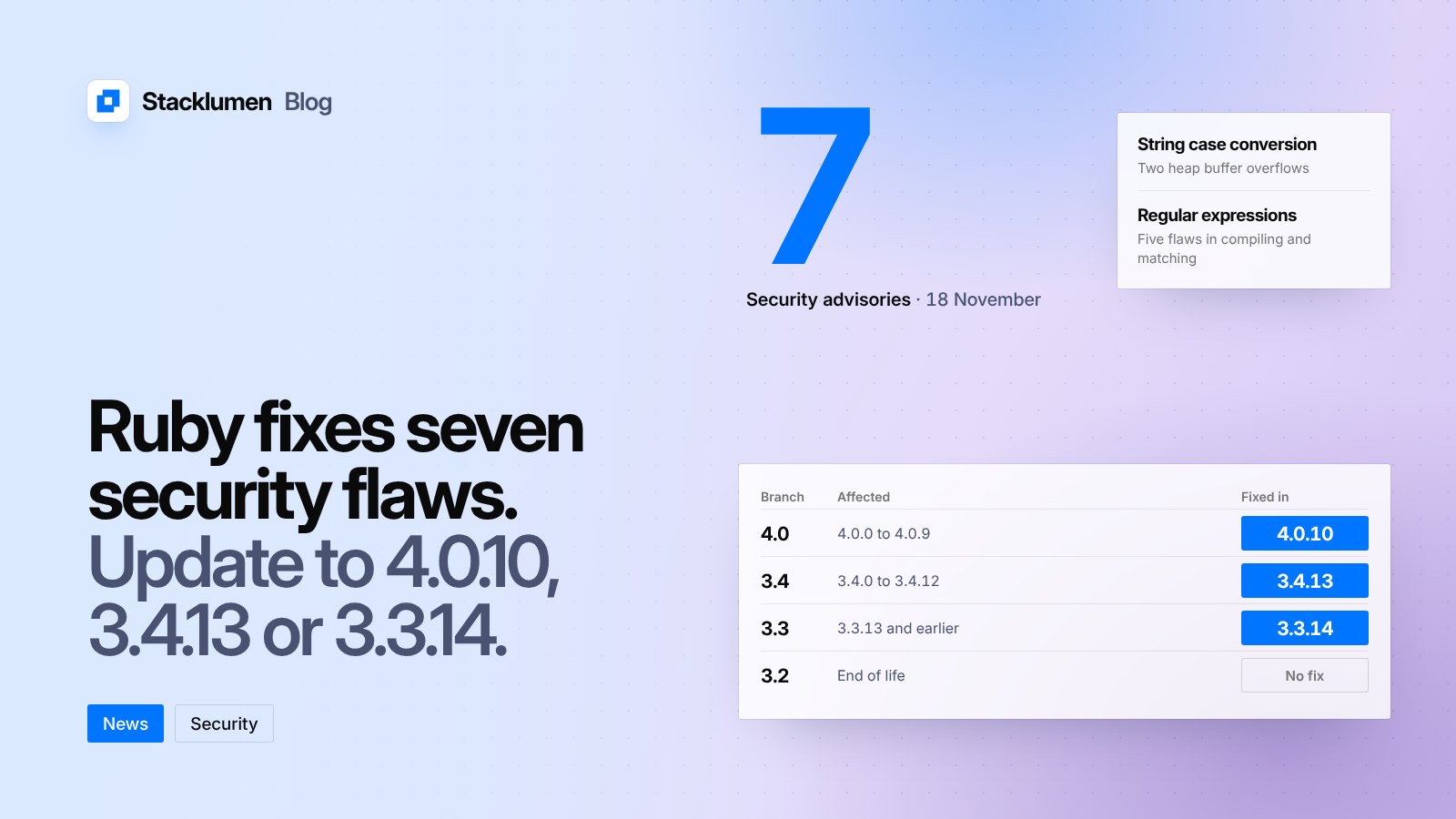
Ruby 4.0.10, 3.4.13 and 3.3.14 fix seven flaws in string case conversion and regular expressions, some of which may allow remote code execution. Ruby 3.2 and earlier get no fix.

On this page
The Ruby team released Ruby 4.0.10, 3.4.13 and 3.3.14 on 18 November 2026. The releases fix seven security flaws in two parts of the language: the regular expression engine and the code that changes the case of strings. The Ruby team says some of the flaws have public proof-of-concept exploits that can lead to remote code execution, and it strongly recommends upgrading.
If your site, an app behind it, or a tool your team runs is written in Ruby, this update is for you.
Which versions are affected
The advisory lists three affected ranges:
- Ruby 4.0.0 to 4.0.9, fixed in 4.0.10
- Ruby 3.4.0 to 3.4.12, fixed in 3.4.13
- Ruby 3.3.13 and earlier, fixed in 3.3.14
Ruby 3.3 is in security maintenance, so it still gets these fixes. Ruby 3.2 and earlier are end of life and will not be patched. If a project is still on 3.2 or older, the only fix is to move it to a supported branch.
What the seven flaws are
The Ruby team published each flaw as a GitHub security advisory. CVE numbers have been requested but were not assigned when the advisories went out, so they are listed by their advisory IDs for now.
String case conversion (two flaws). The first is a one-byte heap buffer overflow when Ruby changes the case of a string. The Ruby advisory rates it Critical and says it affects some single-byte encodings, such as ISO-8859-1 and Windows-1252. Changing the case of a crafted string may allow remote code execution. The second is an integer overflow in the same area that leads to a heap buffer overflow, and may also allow remote code execution.
Regular expressions (five flaws). These sit in how Ruby compiles patterns, matches them and turns them back into text:
- A double free when compiling a pattern.
- An integer overflow that causes a heap buffer overflow during compilation.
- An out-of-bounds read in case-insensitive matching.
- A heap buffer overflow in
Regexp#to_s, which turns a pattern into a string. - An out-of-bounds read in case-insensitive backreference matching, which may disclose memory or crash the process.
For most of the regular expression flaws, the risk is highest in applications that compile patterns an attacker controls. If your code builds a Regexp from a form field, a URL parameter or anything else a visitor sends, treat this update as urgent.
The advisory lists no workaround
The case conversion advisory gives no workaround. Its only advice is to upgrade. The release notes for 4.0.10 say it also includes other bug fixes, listed in its GitHub release notes.
What it means for your site
- Find out where you run Ruby. That includes the server behind a web app, background jobs, build scripts and tools on the machines your team uses. Run
ruby -vin each place. - Upgrade to 4.0.10, 3.4.13 or 3.3.14. Pick the release on the branch you already use. Moving within a branch is the smallest change.
- Rebuild containers and redeploy. A Docker image or a build cache keeps the old Ruby until you rebuild it. Check that the new version is what is actually running in production after you deploy.
- Plan a move off Ruby 3.2 and older. They will not receive these fixes.
- Check apps that ship their own Ruby. If you host a third-party app that bundles a Ruby runtime, watch for its own security release and apply it when it lands.
- Review where you build regular expressions from user input. Even after the update, building patterns from untrusted input is worth avoiding where you can.