WebKit adds a Global Privacy Control API for apps
Apps built on WebKit can now let users send the Global Privacy Control opt-out signal to the sites they open. Here is what the signal is, what California law says about it, and what to check on your site.

On this page
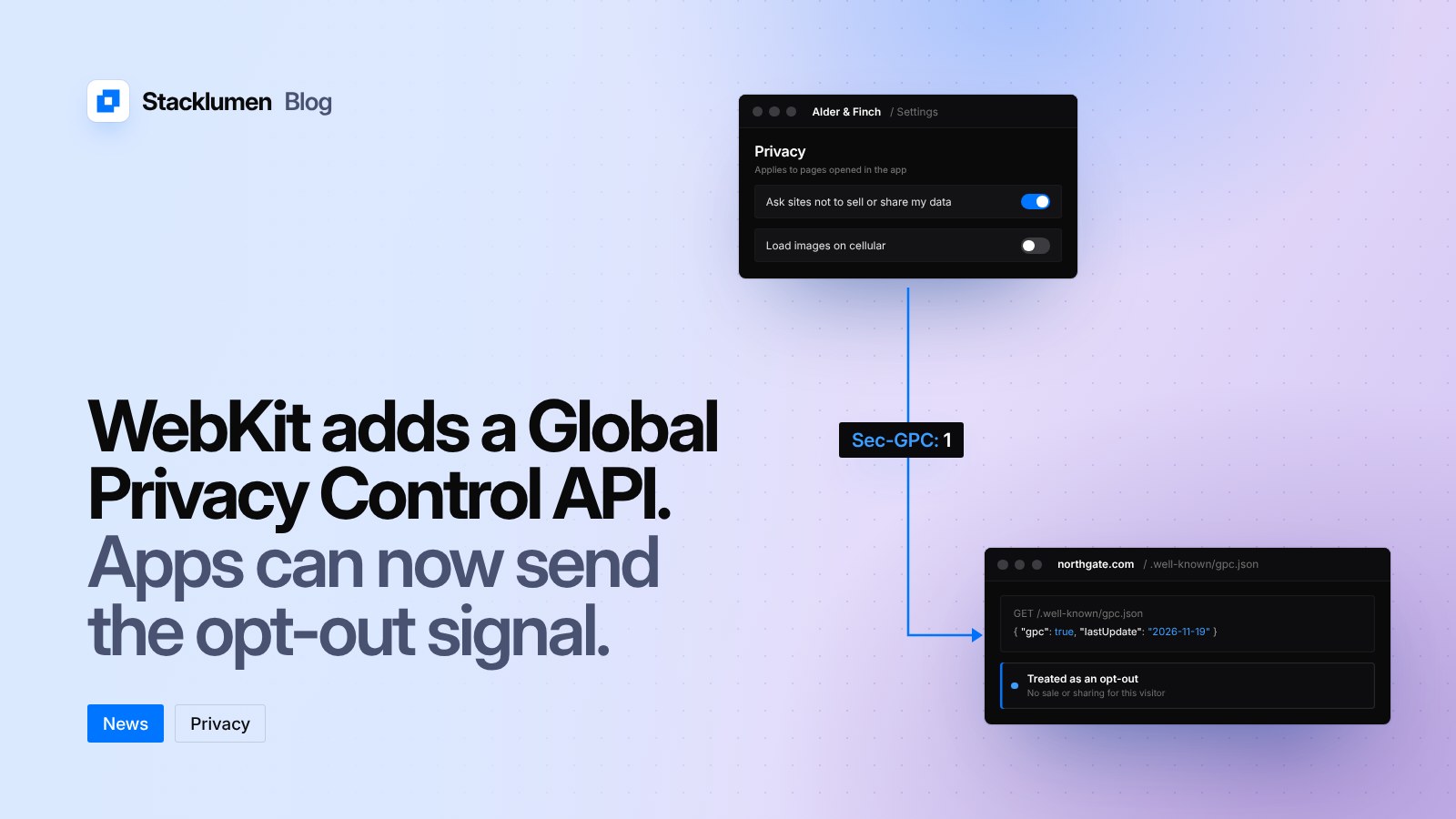
Apple's WebKit team has published a Global Privacy Control (GPC) API for apps that show web pages. Starting with iOS, iPadOS, visionOS and macOS 27, an app that uses WebKit can let its users turn on GPC, and the pages it opens will then receive the GPC signal. For site owners, that means the opt-out signal can now arrive from more places than a handful of browsers and extensions.
What Global Privacy Control is
GPC is a way for a person to tell every site they visit that they do not want their data sold or shared. The W3C specification describes it as "designed to allow users to express a preference to opt out". It is currently a W3C Working Draft, dated 24 September 2026, so details may still change.
The signal takes two forms:
- A request header. When the preference is on, the browser sends
Sec-GPC: 1with its requests. When it is off, no header is sent at all. The specification says servers must ignore the header unless its value is exactly1. - A JavaScript property.
navigator.globalPrivacyControlistruewhen the header would be sent, andfalseotherwise. It is available in pages and in workers.
What WebKit has added
The new API is for app developers, not a switch in Safari's own settings. WebKit's post describes it this way:
- Apps using
WKWebViewsetglobalPrivacyControlEnabledon theWKWebpagePreferencesobject they return when deciding whether to allow a navigation. - Apps using SwiftUI's
WebPagesetisGlobalPrivacyControlEnabledonWebPage.NavigationPreferences. - The setting applies to the whole document tree that navigation produces. The main frame, its subframes and their subresources all get
navigator.globalPrivacyControland theSec-GPC: 1header.
The post presents it as an opt-in that the app developer ties to a user setting of their own. It does not say the signal is on by default.
Why it matters legally
In California, the signal is not just a courtesy. The California Attorney General's page on GPC says that, for businesses that sell or share personal information and collect it online, a user-enabled global privacy control is a valid opt-out request, and "it must be honored by covered businesses as a valid consumer request." The page names Firefox, DuckDuckGo and Brave as browsers that already offer the setting, along with browser extensions.
More apps sending the signal means more of your visitors may be making that request, whether or not you have checked for it.
Telling sites you support it
The specification also defines an optional file an origin can publish at /.well-known/gpc.json, served as application/json. It holds two members:
gpc:trueif the site intends to honor GPC at least as far as the law requires,falseif it does not.lastUpdate: the date the statement was made.
Without the file, a site's support is treated as unknown. The specification also says publishers who accept the signal should disclose how they treat it in each jurisdiction, and how they handle conflicts with choices a person has already made on the site.
What it means for your site
- Find out whether you sell or share data. The signal is aimed at the sale of personal data and its sharing for cross-context targeted advertising. If a site you manage does either, for example through advertising tags, the signal is relevant to it.
- Check that the signal is read. Your consent banner or tag setup should treat
Sec-GPC: 1ornavigator.globalPrivacyControl === trueas an opt-out of sale and sharing, without asking the visitor to click anything. - Test it. Turn GPC on in a browser that supports it, load the site, and confirm that the tags you expect to be blocked do not load.
- Update the privacy policy. Say plainly how the site responds to the signal.
- Consider publishing
/.well-known/gpc.json. Only setgpctotrueonce the site actually honors the signal. - Do not read more into it than it says. The specification notes that sites should not assume the signal invokes every privacy right, such as deletion.
If you build apps that show web content, the WebKit post includes Swift and Objective-C examples for wiring the setting to your own preference.